By M H Ahsan
The outsourcing boom that has transformed this country's economy can be traced in part to a technology discovery made in 1995.
That year, engineers at Tata Consultancy Services found that a set of software tools called CasePac, developed to convert code for IBM, could be used to change the date field in other programs.
"We realized this could be used for the Y2K problem," said Nagaraj Ijari, a senior executive at Tata's offices, located in this city at the epicenter of India's thriving technology industry. Companies from around the world sought Tata's outsourced services to fix the "millennium bug," and the company's annual revenue has climbed from less than $170 million to $2.24 billion in the years since.
The success story illustrates how quickly India's fortunes have changed in just a few short years, as the country's burgeoning technology industry has provided such services at a fraction of the cost of Western counterparts. Building on this foundation, India is now entering an important new phase in its economic evolution.
Once fairly anonymous organizations hired to run support desks and develop server applications for large multinational corporations, Indian companies are raising their profile as brand name suppliers in hardware design, software development, consulting services and virtually anything else in technology. Infused with new blood from a young tech-savvy work force, the new movement is a major advance toward economic independence that carries broad ramifications for a country whose past includes colonial rule, experiments in socialism and devastating poverty.
"There is a huge Indian domestic opportunity and an export opportunity beyond outsourcing," said Rishi Navani, managing director of WestBridge Capital Partners, a venture capital firm specializing in Indo-American deals. "Over the next 12 months, you will see three to four new Indian Nasdaq listings."
India's growing entrepreneurial spirit is reflected in its forays into consumer electronics--a highly competitive market that has long been considered the province of Japan, China, South Korea and other Asian nations, as well as the United States.
Tata recently won a deal to create an environmentally friendly cell phone for a U.S. carrier, for example, while rival Wipro Technologies is designing MP3 players for Europe and a flat-panel TV for an American company. Such entrepreneurial ventures in the consumer market are not confined to the largest players: Mumbai-based Celetronix produces set-top boxes for a U.S.-based satellite TV carrier.
"Our evolution will be similar to the evolution of Taiwan," said Ramesh Emani, president of Embedded & Product Engineering Solutions at Wipro, noting that in India, there would be greater emphasis on hardware design than on manufacturing.
As was the case in China, domestic demand is a significant factor in India's technological expansion.
India has only 100 million phones for its population of 1 billion people--including both cellular and land lines--but that number is expected to grow to 250 million in the next two years. Cellular service costs only about $4 to $7 a month, and future phones will also sport cricket scores, lottery ticket purchases and other types of services seen in South Korea and Japan.
"The volume is enormous," said Sanjay Nayak, CEO of network equipment specialist Tejas Networks, which has won large contracts in India against multinational competitors.
High growth is also expected for the computer market in India, which counts only 14 PCs for every 1,000 people. Several companies hope to court that market with computers priced at less than $250, many of them packaged with residential broadband service that costs about $12 a month for a 128kbps connection.
"It is our fastest-growing emerging market," said Ketan Sampat, president of Intel India. "We've had a growing middle class. PCs are part of that."
Beyond the home, some hardware companies are targeting the enterprise market in and outside India. VXL Instruments, for example, delivers stripped-down desktops to the likes of Air France and Goodyear Tire & Rubber.
New Delhi's FinalQuadrant Solutions sells a server appliance for the travel industry. Travel agents pay only a modest amount for the server but hand FinalQuadrant a small fee for each hotel room night or travel leg booked through the system.
"We're making every single (travel) reseller as powerful as Expedia," CEO Anuj Gupta said. The company, which made $1 million in net profit in 2004, has mostly sold its products in Europe and is expanding to the United States.
For India's service companies, perhaps the most natural expansion is the consulting business. Outsourcing stalwarts such as Tata, Wipro and Infosys Technologies have begun significant consulting operations as outgrowths of their outsourcing work. Each of these "Big Three" companies has seen revenue grow in the 30 to 50 percent range every year for the last five years--a period in which Western companies saw revenue flatten or decline.
Most of their consulting engagements largely address how best to implement services already provided by these companies. But they are nevertheless long-term commitments that will pit them against the formidable white-collar armies at large U.S. companies for years to come.
"We are not McKinsey. We do not want to hand over the report and run away," Tata's Ijari said. "Our competitors are Accenture and IBM."
The new competition on many fronts from India has prompted U.S. companies to increase their presence in the country. Western companies such as Sun Microsystems and Hewlett-Packard have set up shop in India as part of the outsourcing trend, to keep engineering labor costs in line with those of their competitors. But U.S. companies face a problem: Other types of employees, such as managers and sales executives, also have relatively low salaries--meaning they cost India rivals less.
Such concerns explain why U.S. venture capitalists are increasingly insisting that any U.S. start-up seeking funds maintain a presence in India. A company might cost $50 million to $70 million to build in the United States but, with relatively inexpensive labor overseas, might cost $12 million to $20 million in India.
U.S.-Indian businesses can take all manner of hybrid forms. Some were conceived in the United States and have built research and engineering departments in India. Others were born in India but have located high-level executives in America. Still others, such as Tejas and Telsima, are founded and based in India.
Whatever the mix, functions often monopolized by Silicon Valley in the past are now spreading overseas. To lure new investment, for instance, Silicon Valley Bank brought a number of American venture capitalists to India in September 2003 and subsequently opened offices that it lends to visiting VCs and their budding start-ups.
"Before, India was an afterthought," said Ash Lilani, head of global sales and marketing at Silicon Valley Bank. "Now it is thought of at birth."
From blackouts to corruptionStill, challenges persist. With an estimated 600 additional cars on Bangalore's streets every day, traffic has ground to gridlock. The five-mile drive to Electronics City, the main tech hub, can take an hour from the center of town. An express road that was supposed to have been completed last year remains a tangle of rebar and cement pilings.
Electricity is another pressing concern. In nearly every Indian city and state, power outages occur fairly regularly. The lack of an adequate power grid is one reason that no foreign company has built a semiconductor fabrication facility in the country. A South Korean entrepreneur has signed a preliminary agreement to build a chip foundry near Hyderabad, but many sources privately doubt that the project will get far, because of the water and power demands of a modern fab plant.
"The government realizes that there needs to be foreign investment" in infrastructure, WestBridge Capital's Navani said, adding that development funds are being negotiated with large banks.
Tech companies also routinely complain about India's tax system. On the plus side, the onerously large import duties of the past are fading away, and the government has passed laws requiring the equivalent of benefits offered by places like China and Taiwan, including one that gives companies exporting tech products a 10-year exemption from income taxes.
Yet executives are well aware that the government has a history of adding taxes through its national budget, as exemplified recently with a so-called fringe benefit tax. Under this provision, companies that throw parties for clients or host them at conferences must pay a tax on the expenses, said Ravi Pradhan, India manager for Via Technologies.
Moreover, as in other parts of the world, corruption remains a problem when it comes to influencing clients and government officials. "In America, you might take them to the Super Bowl. Here, you give them money," one source said.
And even for Indian entrepreneurs who know how to navigate the unofficial ways of doing business, help from multinational manufacturers is still necessary to build their industry.
"We have engineers who are good technicians, but we need product managers," said Vinod Dham, founder of NewPath Ventures, a venture capital firm that specializes in Indian investments. The services business, he added, has "made a culture of people who say, 'Tell me what to do.'"
Reverse outsourcingThis should lead, at least in the near term, to a form of reverse outsourcing, with U.S. experts heading overseas to provide services for Indian businesses. Indian-based companies, for their part, will need to install an increasing number of employees in Europe and North America to land contracts--which means paying higher Western salaries.
"You need guys who worked on Wall Street," said Jessie Paul, head of marketing for iGate, a Bangalore-based company that provides consulting and other information technology services.
However, while these factors may temporarily slow progress, few expect it to stop the industry. Many Indian companies are becoming more integrated into the business processes of their customers, making offshore outsourcing a permanent arrangement.
"The level of people who are visiting us today is very, very high. They are actually the strategic decision makers. In the dot-com days, it was more reactive," said Srinath Batni, a board member of Infosys. Outsourcing, he added, "has become a long-term strategy."
That marathon approach is viewed as a key advantage for India. Many executives and entrepreneurs note that India's tech boom is driven by a demographic bubble that will be difficult to match for other nations. India has a large population of young people who are driven, well-educated and work for relatively low wages.
"The average age of the working population in India is 27 years," said Supratim Sarkar, manager of strategic marketing at Wipro. "That is one of the biggest levers we have."
Not surprisingly, optimism is running high as younger generations come of age. The national exuberance has inspired many entrepreneurs, including Rajesh Jain, who sold an Indian-based Web portal, IndiaWorld, for around $100 million in 2000 and who is now incubating companies that he expects will bring computing to the masses in his country.
"For the first time," he said, "there is confidence that tomorrow will be better than today."

Sunday, April 23, 2006
Rate this posting:
 Rate this posting:
 By M H Ahsan
Change, challenges and massive growth; Saudi Arabia's sluggish IT sector is speeding up. Gitex Preview looks at the issues, and the opportunities, for Saudi IT managers.
Eighty percent of the Gulf’s IT spending; a projected IT sector annual growth rate of more than 20% to 2008; and massive budget allocations thanks to vast oil revenues: whatever way you look at the Kingdom of Saudi Arabia (KSA), it is the key market in the Gulf..
What is most interesting, though, is the extent to which the KSA IT sector is still largely undeveloped, even compared to other Middle Eastern countries. According to a 2005 Business Monitor International (BMI) report, IT spending accounts for only 1.6% of the Kingdom’s GDP, compared to 2% for tiny Bahrain, and 3.3% for the US. Clearly KSA’s IT sector has huge potential for growth, especially with oil prices continuing to ride high, and the government keen to make the most of the resulting surpluses.
Essam Al Bakr, vice president at Digicom, expects IT spending to reach US$6 billion — US$6.5 billion this year, up from analyst estimates of US$3.2 billion for 2005, which may themselves be well short of the true figure. He says a lot of this spending will come from government ministries and public sector bodies as they are forced into automating their systems by the central government. According to Al Bakr, there has been a degree of reluctance to implement sorely needed reforms of IT infrastructures, but the mood in public sector circles has now changed.
He says, “The Saudi supreme consul gave an ultimatum to all ministries to be automated by 2007; this ultimatum was issued a year or two ago, but some ministries have been struggling with their own problems — we have a heavily bureaucratic system.
“Now King Abdullah has delivered a message saying, in effect: ‘I don’t want you spending your budgets at the last minute — you’ve got to start spending, implementing and finishing from day one’. For the ministries, that is message enough that they have to bring in IT automation now, knowing they’ll be evaluated at the end of the year on their progress. There’s a big movement going on in the public sector,” continues Al Bakr.
Khaled Al Mobarak, vice president of the SAP Users Group Arabia (SUGAr), says, “I worked for the Ministry of the Interior (MoI) for three years, and I still try to keep up with the events in the IT departments in the ministries. The MoI is implementing an IT solution for their financial section, and there is an increasing move towards similar projects in other departments.”
Al Mobarak, who works at the IT department in a major Saudi state oil concern as well as his SUGAr duties, says his department has received a large number of visits from government sector officials, to look at how IT solutions are implemented, and the benefits they can bring. He acknowledges, though, that there is some resentment of the changes being forced on departments, but says this is only natural.
“It’s human nature — no one likes to change. But I think the ministry officials see the truth in the saying: ‘if you don’t ride the wave of change, you’ll find yourself beneath it’. The wave of change in IT is coming, and if you don’t ride it you’ll be drowned, you’ll be obsolete,” says Al Mobarak. “The same process occurred in other sectors; if you look at banking five or six years ago here, all the banks had big lobbies, lots of cashiers, and that was what you looked at. Now, you look at if the bank has internet facilities, how secure they are, how fast they are — no one cares how big the lobby is anymore.”
Aside from governmental organisations and their own special challenges, observers of KSA’s IT sector most often single out finance as one of the key drivers of technological change in the country’s economy. Organisations such as Riyad Bank, Arab National Bank (ANB) and Tadawul, the Saudi stock exchange (now trading stocks worth in excess of US$600 billion), have all recently deployed impressive and often advanced IT solutions, including VoIP, business intelligence (BI) and enterprise resource planning (ERP) systems, to deal with business challenges, not just technical ones.
ANB’s IT manager, Saad Al Khalb, has recently overseen the implementation of a VoIP system throughout the bank, and says, “We’ve seen a dramatic increase in call volumes. In January 2005, we had 300,000 calls, and in October 2005 we had more than one million. With the fast growth we’re seeing in Saudi Arabia, we’re expecting the bank’s business to keep expanding dramatically. We don’t know exactly what new developments we’ll see, but the VoIP system will give us the flexibility to cope with the future.”
Meanwhile, the senior vice president for IT at Riyad Bank, Rashed AlOthman, is busy working on a BI and data warehousing project at the moment. He says the business side of the bank has been very impressed with the potential offered by such projects, and this has given Riyad Bank the impetus to work on what is an ambitious and advanced implementation project for any organisation. Other sectors driving IT development in the Kingdom include education, healthcare and manufacturing. In the realm of healthcare Saudi Arabia has some of the most advanced hospitals in the world in certain areas, but the CIO of the King Faisal Specialist Hospital in Riyadh, Hamad Al-Daig, says many hospitals in KSA, especially those under the Ministry of Health, are behind their counterparts elsewhere in the world in IT terms, although for some this is changing.
“Tertiary care organisations under bodies such as the National Guard and the Army are behind, but they are catching up,” says Al-Daig, echoing the impression given by others of many government organisations in KSA: “Unfortunately, the Ministry of Health hospitals are not implementing the solutions they should be, in spite of our urging, our presentations to get them to change. I think they have other issues to contend with; they do not want to deal with IT, but we are trying to convince them that IT is the way to solve these problems. IT is the main solution, and they should not look at it as an expense, but as the only way they can move forward.” Al-Daig, who is in charge of an IT staff of around 100, is currently working on a number of IT projects at the hospital, including a clinical information system, an ERP and a data warehousing solution. While these projects are advanced, and grounded in business necessity, Al-Daig says IT budgets are still too low; his 180m Riyal (US$48 million) budget, while impressive as a headline figure, is actually just 2% of the total hospital budget. Most analysts suggest a healthy IT spend should be closer to 5% of the total budget.
Education, another sector set to spend heavily on IT in the near future, is also one of the most controversial topics for Saudi CIOs. In the budget for 2006, the Saudi government has allocated 87.3bn Saudi Riyals (US$23.3 billion) to education and manpower, an increase of almost 30% over 2005’s budget allocation. The government has ambitious plans for 2,673 new schools, 15 vocational training centres and three new technical colleges; while most of the funds will go on basic construction, IT infrastructure will become increasingly important in managing these organisations, as well as dealing with the increased number of students entering higher educational establishments and requiring technical training. But while the government is prepared to spend money to ensure Saudis have access to proper education, IT managers are complaining that they don’t have access to the numbers of skilled IT professionals they require to develop their organisations and deliver high-quality implementations. This problem is compounded by ‘Saudisation’, the stipulation that organisations must have a certain proportion of Saudi nationals in their workforces, and must only hire Saudis for certain positions. Anecdotal evidence suggests that some companies are actually creating fake jobs for nationals in order to fill the quota because they are unable to find Saudi staff with the necessary skills.
Yasser Al-Farhan, managing director at Somac-IT, a KSA-based integrator, says, “One key issue is locals who do have skills are always looking for better deals, and will move companies quite often. It’s not like in the past, when you would be with a company for life. Keeping talented Saudis in your organisation is a big challenge, especially with these mega-projects on the horizon — the big companies will always be hunting them. At the moment I think Saudisation is a limiting factor; in the long term it is obviously a good thing, but now I think it is holding development back.” Nadec’s IT manager, Khalid Al-Shangiti, agrees with this, and says that skilled Saudis do not even go after the best-paid jobs, but seek positions in the most prominent or high-profile companies, at least for a few years of their career, making it even harder for less well-known enterprises to take advantage of their skills. Al-Shangiti says Nadec’s management are very keen to use IT to drive the business. The company produces a range of food products, and has an annual turnover of around 702 million Riyals (US$187.2 million). “The skills problem can be solved by starting at an earlier level of education, not when students graduate,” says Al-Shangiti. “When people come out after four years of university, they’ve got good ideas and good understanding, but it will still take them another two years to understand the business. What companies and vendors should do is get involved while students are still in university. If we act proactively we can get students to focus on the real IT needs of Saudi Arabia; at the moment many graduates know a lot about ERP, for example, but they can only talk about a ‘dream’ version, not the reality for most Saudi companies.” He suggests getting students to look at real-life IT situations and cases at university will enable them to understand how companies in KSA use IT and see technology, and give companies the chance to take advantage of the students’ skills at an earlier stage. But Al-Shangiti acknowledges that, in addition to the challenge of building Saudi nationals’ skills, KSA organisations are often plagued by a lack of specialist personnel to help deploy complex vendor offerings, something echoed by every other IT manager included here. Riyad Bank’s AlOthman says, “One of the key issues we have faced recently is with multinational vendors’ unwillingness to bring skilled people into Saudi to help implement their solutions, because of the security problems KSA has had in the last few years. This is an issue which has dramatically affected our business in the past, simply because we can’t get access to the skills we need. The biggest challenge for CIOs in the Middle East is simple: finding the right human resources. Anything else can be arranged, but if you don’t have qualified people, that’s a big problem.” Aside from the key issue of education and skills, the other major challenge facing Saudi enterprise IT departments is the corporate culture among Saudi business leaders, and their attitude towards IT. While in many ways this is a common problem, not just in the Middle East, but worldwide, Saudi Arabia faces its own particular problems, in addition to the politics and assumptions common to all big businesses. “In Saudi Arabia, most of the business leaders are Arabic speakers only; they speak very little English,” comments Nadec’s Al-Shangiti. “At the same time, a lot of IT specialists speak no Arabic. If we try to translate between them, then 20% of the sense is lost straight away. A lot of the Kingdom’s problems with IT can be traced back to the issue of communication, in my opinion.” Ayman Safadi, strategic planning and business development manager at KAB Holdings, sees the decision-making process used in Saudi businesses as one of the key challenges in making sure IT is deployed effectively, and ensuring the business benefits of technology are recognised. Safadi formerly worked at Accenture in both Saudi Arabia and Dubai.
“The way decisions are taken in many organisations is often along the lines of a ‘slow and steady’ approach,” he says. “Many people favour a gradual process of change over a wholesale shift, and this can be a barrier for IT when the benefits sometimes only come with a major change. Another factor is the budget cycle; for the past four to five years, spending has been very tight. Because of this as well, decision-making became slower.” Safadi says the internal market is now adjusting itself following KSA’s entry into the WTO late last year. This, he says, is causing a slew of mergers within the country’s IT sector, and is also encouraging the use of outsourcing in the national market. Other observers, such as the general manager of Oracle Saudi Arabia, Abdul Rahman Al Thehaiban, agree that the market is now changing and companies are becoming more accepting of IT, out of necessity. “Many companies have been reluctant to invest in IT, because of the perception that it’s unreliable and that it involves ongoing expense,” explains Al Thehaiban. “But now the trend is changing, and many companies now look at IT as the main contributor to business growth. People have been able to see the impact IT has made to the financial services industry and recognised the value IT can bring,” he says. Something that still remains a challenge for any enterprise wishing to operate over the whole of Saudi Arabia’s vast area is the deceptively simple issue of communication. ANB’s Al Khalb says the bank has faced problems operating over the country’s huge geographical area; ANB even had to use virtual call centres in Dammam and Jeddah to route customer calls, to avoid punitively expensive charges from the Saudi Telecom Company (STC) for long distance phone connections.
Cisco’s Dr Badr Al Badr, general manager of the network giant’s KSA division, says this is now changing, however, as STC prepares to introduce 600,000 new lines over the next two years, as well as digital subscriber line (DSL — high-speed internet connections) facilities, across the country. “We also have two data telecom challengers who are expected to start offering their services within a few months,” says Al Badr. “This should help deal with enterprises’ bandwidth issues. I think IT and communications technology is now becoming accepted; in a recent survey we conducted among small and medium enterprises, competition was rated as the number one concern, and 70% of respondents said IT is one of their key tools to deal with competition. When it comes to larger enterprises, I think this will probably be even more true.” The impression from many people in KSA is that, leaving aside government ministries, the country’s large enterprises have begun to utilise IT effectively and recognise its business benefits, although smaller organisations still lag behind in this area. Humansoft’s VP, Mohammed Hassoun, agrees with the view that, outside of the largest companies, there is an incredible amount of room for improvement. But overall he gives a positive picture of the short-term and long-term prospects for KSA’s IT sector. “There’s a lot of hope on the horizon, I think,” says Hassoun. “There are a large number of programmes to bring up the educational standards in Saudi Arabia. As regards enterprises, the top 200 companies in Saudi have come a long way in improving how well IT is aligned to the business.” “They see that when they invest the right way in IT the ROI can be very high, and this has happened over the last three years. CEOs have begun to sponsor IT projects now, and I think business leaders really do understand the value of IT,” he concludes.
As one of the country's newer public bodies, Saudi Arabia's Supreme Commission for Tourism (SCT) had something of a head start in developing a modern IT infrastructure. Abdullah Al-Mosa, assistant deputy secretary general for IT at SCT, is certainly very proud of his department's accomplishments in information and communication technology. "SCT was founded five years ago, and it came to light in the era of technology; this helped in avoiding migration from the legacy architecture to the new trend of IT," says Al-Mosa. "All the applications being used, as well as the infrastructure and backbone, are selected very carefully. So at the moment we have nothing to worry about ageing, or migrating from old to new systems." SCT is in many ways a very public face to the Saudi Arabian government sector. The department has been charged with developing the Kingdom's tourism sector, which includes managing aspects of the mighty Hajj twice a year. The commission's secretary general, His Royal Highness Prince Sultan ibn Salman ibn Abdulaziz Al-Saud, also brings a high-profile element to the organisation; he was not only the first Arab in space - going up with a US space shuttle crew in the 1980s - but he has also won a number of accolades in recent years, most notably Saudi IT man of the year in 2003. "Because of our achievement under the vision and direction of Prince Sultan, this adds a little bit of pressure for SCT to become the ideal model for IT and e-government," says Al-Mosa. "Partly out of this came a move for someone from SCT to sit on the e-government advisory body, which I am now doing." The IT head says that implementing e-government in the Kingdom is complicated by the requirement to integrate and align one department's system with that of a number of others. Al-Mosa gives the example of having to make sure SCT's policies are in line with Ministry of Finance guidelines. Despite this, he says, SCT has succeeded in implementing a number of projects in what is excellent time. These include the deployment of an ERP system from Oracle in one year. The biggest challenges involved in the implementation were not technical, but revolved around the human side of the equation.
"One of the challenges was training professionals to set up the implementation plan, the project plan, and the management. “ Because SCT is such a young organisation, integrating people from different backgrounds, the public and private sectors, has been something which we've had to work very hard on. Everybody played their roles properly, but integrating all of the roles was the challenge ," comments Al-Mosa. "The other major human aspect was preparing people for the change. I think there is always a fear of what you don't know, and a resistance from people, so you have to work at training them, educating them to deal with the new application and make sure it is adopted effectively. By doing this we were able do implement not just the ERP but a whole range of other systems as well." In addition to the ERP system SCT has also deployed applications from FileNet, GIS and other vendors, including document management, content management and workflow systems. Al-Mosa says that by bringing in modern systems without the hindrance of legacy applications, SCT has been able to create a modern, efficient infrastructure to build on. Even with this being the case, though, the SCT IT chief says the organisation had a big leap in productivity when the ERP system came into use, with a number of areas benefiting specifically. "We saw a big improvement in efficiency, in productivity, in path-processing, in accuracy when we brought in the ERP," Al-Mosa says. "Communications was another area where we had a big benefit from the new system; most of our applications are web-enabled, so this allows our employees to communicate from anywhere in the world - it doesn't matter where they are. So if you are on a business trip, and someone needs your opinion on a subject, it is simple to log into the application remotely and do whatever needs to be done." Al-Mosa is enthusiastic about remote working for his department’s staff, and brings up the organisation's video conferencing solution, which leverages the commission's existing wide area network (WAN) to help save time and money. "We have provincial tourism offices scattered across Saudi Arabia, so instead of asking them to travel to Riyadh we can use video conferencing technology to hold meetings. This means that our employees save time by not having to fly and save money as well. We have our WAN in place for all our other applications, so this is a natural extension of it, to use it for video conferencing," explains Al-Mosa The future of SCT's IT implementations are firmly in the e-government vein. Al-Mosa remains tight-lipped about any specific solutions in the longer term, but he does mention the upcoming e-visa programme, which will be launched within a couple of months, and has already been publicised in the Saudi Arabian press. Al-Mosa says SCT's objective is to make the processes for getting into Saudi Arabia easier for tourists and businesspeople, and the e-visa project is a key part of this. His enthusiasm and belief in the Kingdom's IT situation is very apparent, and he talks with great zeal about various government initiatives to increase computer literacy. That he remains slightly cagey about the commission's e-government plans is perhaps understandable, given his opinions on the organisation's leading role among Saudi government bodies, but he is clearly committed to the cause. And Al-Mosa's mantra for success is also clear, and has obviously informed his investment decisions at the head of the SCT's IT department: "If you have proper information, proper analysis, proper trends, you will lead."
Rate this posting:
Rate this posting:
Rate this posting:
By M H AHSAN
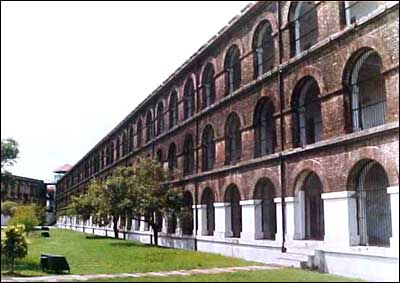
Over 150 Indians who served various sentences in Kalapani jail during the British regime for defying the orders of the administration or rebelling against the system were invited to take part in the celebrations of the 100 years of the establishment of the Cellular Jail on March 10, 2006.
"From the unmatched sacrifices of our freedom fighters to the tyranny of our colonial rulers, from being a torture cell to a place of pilgrimage, this historical monument has come a long way since its establishment 100 years back as a penal settlement. Cellular Jail, stood mute witness to the tortures meted out to the freedom fighters, who were incarcerated in this jail," said a press handout given to mediapersons in Delhi.
It acquired the name, 'cellular' because it is entirely made up of individual cells for the solitary confinement of prisoners. It originally was a seven-pronged, puce-coloured building with a central tower and a massive structure comprising honeycomb like corridors. The building was subsequently damaged and presently only three out of seven prongs are intact. The jail, now a place of pilgrimage for all freedom-loving people, has been declared a national memorial.
Situated in Andaman, Kalapani punishment was meant to serve as a deterrent to Indian freedom fighters fighting against the British. Netaji Subash Chandra Bose hoisted the tri-colour near the cellular jail on December 30, 1943, and proclaimed independence from British rule.
It was the British-run Bengal government, and Governor General of India Lord Cornwallis, who conceived the idea of developing the Andaman Islands, in the Bay of Bengal, as a British colony in the 1700s.
Two officers – one of them was Lieutenant Archibald Blair (that's how Port Blair got its name) -- were sent to survey the area. A settlement was established on Chatham Island in a southeastern bay of the Great Andaman and was called Port Cornwallis (later its name was changed to Port Blair). There was much illness on the islands and the colony did not work out so the settlers were shipped back to the mainland.
The British government had too many prisoners on its hand, post the Mutiny of 1857 and the idea of establishing a settlement – this time a convict colony -- was revived. Some 200 prisoners were sent out initially to a jail, equipped with gallows, at Viper Island 15 minutes from Port Blair, and Kalapani was established.
The construction of Cellular Jail -- which got its name from the fact that it was made up of numerous individual cells it provided for prisoners destined for solitary confinement -- began in 1896 and was completed in 1906. The British authorities arrested hundreds of revolutionaries as more and more rebellions against the British surfaced across India. And hundreds of these prisoners were shipped out to Port Blair and were housed and ill-treated in this jail.
Veer Savarkar, many associates of Sardar Bhagat Singh, several revolutionaries of the Chittagong Revolt were some of the freedom-fighters who spent time at Cellular Jail.
The Andaman and Nicobar tourism authorities are commemorating the history of this jail with special ceremonies today.
Three surviving freedom-fighters -- Bimal Bhowmick, Kartik Sarkar and Adhir Nag -- were invited to Port Blair, as well as spouses, sons and daughters of deceased freedom fighters. There will be special functions to honour the heroes of 1857. Shubha Mudgal and Suresh Wadkar will participate in a special music programme Friday evening.
Rate this posting:
Rate this posting:
 By M H AHSAN
Vivek Oberoi and Fardeen Khan starrer Pyare Mohan lacks the punch of a comedy film. Directed by Indra Kumar, the movie stars Fardeen Khan , Vivek Oberoi , Esha Deol , Amrita Rao and Boman Irani .
Given the movie’s basic story idea, ‘Pyare Mohan’ could have been an interesting flick. Two friends – one blind and the other deaf – go about their lives with fun and masti without letting their handicap become a weakness.
They also fall in love and later on fight the bad guys to save their sweethearts. Pyare (Fardeen Khan) is blind as a bat. Day or night, light or darkness makes no difference to him. He goes on morning walks, reads the newspaper upside down and can sense a man’s intention despite his inability to see.Mohan (Vivek Oberoi) needs just an excuse to break into dance at the slightest opportunity. He is deaf and can’t hear a damn thing, but he shakes his leg to the music, be it a marriage ceremony or (mistakenly) a funeral procession.
Together, Pyare and Mohan are inseparable friends running an Archies shop. But there is something lacking in their lives. It is love.Cupid strikes when the two meet Priya (Amrita Rao) and Preeti (Esha Deol) during a morning walk. While Pyare is smitten with Preeti, Mohan loses his heart to Priya.Preeti and Priya perform at musical shows. Their friendship with Pyare and Mohan cements after the two heroes help them during a concert.
But when Pyare and Mohan express their love to Preeti and Priya, their proposal is turned down. Preeti and Priya admit that they have always seen Pyare and Mohan as good friends but they don’t have any romantic feelings for them. Pyare and Mohan are shattered.Post interval, the two girls get into trouble in Bangkok where they are arrested for a murder. Not only this, an underworld don Tony (Boman Irani) wants to kill them.In this hour of need, Preeti and Priya’s dear ones turn their back to them. Only the blind Pyare and the deaf Mohan, whose love the two belles had rebuked earlier, come to their rescue. What follows is a cat-and-mouse game in which our blind and deaf heroes excel over the baddies.
Indra Kumar , the movie’s director, showed an incredible command over comedy in his movie Masti two years ago. But he disappoints in ‘Pyare Mohan’. Barring a few sequences, the humour in ‘Pyare Mohan’ is pretty mundane.
Vivek Oberoi does evoke a few chuckles in some scenes. His very opening scene, when he is dancing in a marriage and unknowingly starts dancing in front of a funeral along side, is funny. Also the look he wears throughout the movie, reading the lips of people speaking to him, gives his character a hilarious touch.Fardeen Khan looks handsome, but doesn’t impress in comedy.
There are certain scenes in which his expressions are plain wooden.Esha Deol and Amrita Rao react more than act in the movie. Boman Irani is just about ok, playing a stuttering don, who claims his victims with a baseball bat.To sum it up, ‘Pyare Mohan’ had the potential to be an entertaining comedy. But the writers have not been able to do justice to the script. The humour in the movie is obviously predictable and absurdly puerile.
Rate this posting:
INDIAGOSS is an online e-newspaper with a difference. On a mission, with a vision, to put the records straight...on all counts. It arrives on the scene of India's Journalism not as a meek follower of somebody or as a potent 'power' with a solid financial or political backup to fulfill its material goals.
INDIAGOSS is an accredited online gossip news network, it's news blend aesthetics with contents, character and maturity, setting the new standards in Indian events, happenings and issues treated with sensitivity and intelligence. It fight for the causes of Indians living across the world. It speaks the language of liberty, justice and quality.
INDIAGOSS is a comprehensive gossip news portal, updates several times in a day with its latest technology and wide network and most powerful expertise. This portal will give you latest, unreported, unpublished, juicy and informative 'all gossip news' in every walk of life, everyday. Each of our update delivers authoritative reporting and analysis of the India's most important news and events. Our news gathering resources means that you'll get the big picture -- a unique perspective, access to newsmakers and incisive coverage that helps web readers prepare for tomorrow by developing understanding on what is happening today.
'INDIAGOSS' marking its beginning with a difference.
Rate this posting:
Rate this posting:
{[[' ']]}
']]}
']]}Bangalore is home to India's tech elite
By Julia Roberts
On Bangalore's crowded streets, hand-pulled carts compete for space with trucks, cars, and make-shift food kiosks, often bringing traffic to a snail's pace. The heat, the grime, pollution, and potholes on the road make the city quintessentially Indian. But look closely. Cheek by jowl with the noisy bazaars of Bangalore are swanky design and development facilities set up by both multinational and Indian companies. In the cubicles in these premises is where Bangalore's technology innovation thrives, as the city's information technology engineers do software development, design integrated circuits, and even develop products.
Texas Instruments Inc. was the first multinational company to set up a development center in Bangalore in 1985. After TI, a number of multinational companies from the US, Europe, and Japan have set up design and development centers in Bangalore.
For a while after Microsoft Corp. set up its software development center in Hyderabad in 1998, it looked like Bangalore was losing out on new foreign information technology investments to Hyderabad, which is the capital of the neighboring state of Andhra Pradesh, and to Chennai, the capital city of another neighboring state, Tamil Nadu. By 1999, the trend was however reversed when Intel Corp., Sun Microsystems Inc., ZiLOG Inc. and a number of other companies set up design and development centers in Bangalore.
"Sun's decision to set up the center at Bangalore was primarily influenced by two areas in which Bangalore stood out compared to Chennai and Hyderabad, in that order -- availability of people with the right skills, and ability to attract people from anywhere in the world to Bangalore," said Bhaskar Pramanik, managing director of Sun Microsystems' operations in India. Sun's India Engineering Center in Bangalore is an extension of the corporate engineering center in the US, and is expected to be the largest outside the US by June, 2001. "The work being done here is not just in sustaining or support, but in areas which will impact future Sun products and technologies," added Pramanik.
Bangalore is now also home to a large number of Indian technology companies, including Wipro Ltd., one of the country's largest information technology products and services company, and software services company, Infosys Technologies Limited. These companies built up their revenue, primarily by doing contract work for multinational information technology companies like Microsoft, Nortel Networks Corp., and SAP AG, and large, multinational users of information technology.
New entrepreneurs here are, however, focused on creating and licensing intellectual property, and they have not gone unnoticed by multinational companies. Intel, for instance, has invested in Sasken Communication Technologies Ltd., and in early 1999 acquired Santa Clara-based Thinkit Technologies Inc and its Bangalore-based subsidiary, Software & Silicon Systems Pvt Ltd.
Even before the multinational companies discovered Bangalore's potential as a design and development location, Bangalore was already a key location in India for the electronics industry, primarily because the Indian government located a number of government-owned electronics companies and defense research institutions in the city. Besides information technology and communications companies, Bangalore has a large number of manufacturing companies making automobile components, electronic connectors, and a variety of precision engineering products.
But the city did not anticipate the technology boom, and the attendant infrastructure bottlenecks, such as shortage of power and housing in the city. With an area of 366 square kilometers, Bangalore now has a population of 5.2 million, which continues to grow.
New business opportunities, such as the outsourcing by US and European vendors of Internet-based customer relationship management (e-CRM) to Indian companies, are also extending the benefits of globalization to plain college graduates who until recently were left untouched by the technology boom in the city.
On Bangalore's crowded streets, hand-pulled carts compete for space with trucks, cars, and make-shift food kiosks, often bringing traffic to a snail's pace. The heat, the grime, pollution, and potholes on the road make the city quintessentially Indian. But look closely. Cheek by jowl with the noisy bazaars of Bangalore are swanky design and development facilities set up by both multinational and Indian companies. In the cubicles in these premises is where Bangalore's technology innovation thrives, as the city's information technology engineers do software development, design integrated circuits, and even develop products.
Texas Instruments Inc. was the first multinational company to set up a development center in Bangalore in 1985. After TI, a number of multinational companies from the US, Europe, and Japan have set up design and development centers in Bangalore.
For a while after Microsoft Corp. set up its software development center in Hyderabad in 1998, it looked like Bangalore was losing out on new foreign information technology investments to Hyderabad, which is the capital of the neighboring state of Andhra Pradesh, and to Chennai, the capital city of another neighboring state, Tamil Nadu. By 1999, the trend was however reversed when Intel Corp., Sun Microsystems Inc., ZiLOG Inc. and a number of other companies set up design and development centers in Bangalore.
"Sun's decision to set up the center at Bangalore was primarily influenced by two areas in which Bangalore stood out compared to Chennai and Hyderabad, in that order -- availability of people with the right skills, and ability to attract people from anywhere in the world to Bangalore," said Bhaskar Pramanik, managing director of Sun Microsystems' operations in India. Sun's India Engineering Center in Bangalore is an extension of the corporate engineering center in the US, and is expected to be the largest outside the US by June, 2001. "The work being done here is not just in sustaining or support, but in areas which will impact future Sun products and technologies," added Pramanik.
Bangalore is now also home to a large number of Indian technology companies, including Wipro Ltd., one of the country's largest information technology products and services company, and software services company, Infosys Technologies Limited. These companies built up their revenue, primarily by doing contract work for multinational information technology companies like Microsoft, Nortel Networks Corp., and SAP AG, and large, multinational users of information technology.
New entrepreneurs here are, however, focused on creating and licensing intellectual property, and they have not gone unnoticed by multinational companies. Intel, for instance, has invested in Sasken Communication Technologies Ltd., and in early 1999 acquired Santa Clara-based Thinkit Technologies Inc and its Bangalore-based subsidiary, Software & Silicon Systems Pvt Ltd.
Even before the multinational companies discovered Bangalore's potential as a design and development location, Bangalore was already a key location in India for the electronics industry, primarily because the Indian government located a number of government-owned electronics companies and defense research institutions in the city. Besides information technology and communications companies, Bangalore has a large number of manufacturing companies making automobile components, electronic connectors, and a variety of precision engineering products.
But the city did not anticipate the technology boom, and the attendant infrastructure bottlenecks, such as shortage of power and housing in the city. With an area of 366 square kilometers, Bangalore now has a population of 5.2 million, which continues to grow.
New business opportunities, such as the outsourcing by US and European vendors of Internet-based customer relationship management (e-CRM) to Indian companies, are also extending the benefits of globalization to plain college graduates who until recently were left untouched by the technology boom in the city.
{[['']]}
']]}Saudi Soars High
 By M H Ahsan
Change, challenges and massive growth; Saudi Arabia's sluggish IT sector is speeding up. Gitex Preview looks at the issues, and the opportunities, for Saudi IT managers.
Eighty percent of the Gulf’s IT spending; a projected IT sector annual growth rate of more than 20% to 2008; and massive budget allocations thanks to vast oil revenues: whatever way you look at the Kingdom of Saudi Arabia (KSA), it is the key market in the Gulf..
What is most interesting, though, is the extent to which the KSA IT sector is still largely undeveloped, even compared to other Middle Eastern countries. According to a 2005 Business Monitor International (BMI) report, IT spending accounts for only 1.6% of the Kingdom’s GDP, compared to 2% for tiny Bahrain, and 3.3% for the US. Clearly KSA’s IT sector has huge potential for growth, especially with oil prices continuing to ride high, and the government keen to make the most of the resulting surpluses.
Essam Al Bakr, vice president at Digicom, expects IT spending to reach US$6 billion — US$6.5 billion this year, up from analyst estimates of US$3.2 billion for 2005, which may themselves be well short of the true figure. He says a lot of this spending will come from government ministries and public sector bodies as they are forced into automating their systems by the central government. According to Al Bakr, there has been a degree of reluctance to implement sorely needed reforms of IT infrastructures, but the mood in public sector circles has now changed.
He says, “The Saudi supreme consul gave an ultimatum to all ministries to be automated by 2007; this ultimatum was issued a year or two ago, but some ministries have been struggling with their own problems — we have a heavily bureaucratic system.
“Now King Abdullah has delivered a message saying, in effect: ‘I don’t want you spending your budgets at the last minute — you’ve got to start spending, implementing and finishing from day one’. For the ministries, that is message enough that they have to bring in IT automation now, knowing they’ll be evaluated at the end of the year on their progress. There’s a big movement going on in the public sector,” continues Al Bakr.
Khaled Al Mobarak, vice president of the SAP Users Group Arabia (SUGAr), says, “I worked for the Ministry of the Interior (MoI) for three years, and I still try to keep up with the events in the IT departments in the ministries. The MoI is implementing an IT solution for their financial section, and there is an increasing move towards similar projects in other departments.”
Al Mobarak, who works at the IT department in a major Saudi state oil concern as well as his SUGAr duties, says his department has received a large number of visits from government sector officials, to look at how IT solutions are implemented, and the benefits they can bring. He acknowledges, though, that there is some resentment of the changes being forced on departments, but says this is only natural.
“It’s human nature — no one likes to change. But I think the ministry officials see the truth in the saying: ‘if you don’t ride the wave of change, you’ll find yourself beneath it’. The wave of change in IT is coming, and if you don’t ride it you’ll be drowned, you’ll be obsolete,” says Al Mobarak. “The same process occurred in other sectors; if you look at banking five or six years ago here, all the banks had big lobbies, lots of cashiers, and that was what you looked at. Now, you look at if the bank has internet facilities, how secure they are, how fast they are — no one cares how big the lobby is anymore.”
Aside from governmental organisations and their own special challenges, observers of KSA’s IT sector most often single out finance as one of the key drivers of technological change in the country’s economy. Organisations such as Riyad Bank, Arab National Bank (ANB) and Tadawul, the Saudi stock exchange (now trading stocks worth in excess of US$600 billion), have all recently deployed impressive and often advanced IT solutions, including VoIP, business intelligence (BI) and enterprise resource planning (ERP) systems, to deal with business challenges, not just technical ones.
ANB’s IT manager, Saad Al Khalb, has recently overseen the implementation of a VoIP system throughout the bank, and says, “We’ve seen a dramatic increase in call volumes. In January 2005, we had 300,000 calls, and in October 2005 we had more than one million. With the fast growth we’re seeing in Saudi Arabia, we’re expecting the bank’s business to keep expanding dramatically. We don’t know exactly what new developments we’ll see, but the VoIP system will give us the flexibility to cope with the future.”
Meanwhile, the senior vice president for IT at Riyad Bank, Rashed AlOthman, is busy working on a BI and data warehousing project at the moment. He says the business side of the bank has been very impressed with the potential offered by such projects, and this has given Riyad Bank the impetus to work on what is an ambitious and advanced implementation project for any organisation. Other sectors driving IT development in the Kingdom include education, healthcare and manufacturing. In the realm of healthcare Saudi Arabia has some of the most advanced hospitals in the world in certain areas, but the CIO of the King Faisal Specialist Hospital in Riyadh, Hamad Al-Daig, says many hospitals in KSA, especially those under the Ministry of Health, are behind their counterparts elsewhere in the world in IT terms, although for some this is changing.
“Tertiary care organisations under bodies such as the National Guard and the Army are behind, but they are catching up,” says Al-Daig, echoing the impression given by others of many government organisations in KSA: “Unfortunately, the Ministry of Health hospitals are not implementing the solutions they should be, in spite of our urging, our presentations to get them to change. I think they have other issues to contend with; they do not want to deal with IT, but we are trying to convince them that IT is the way to solve these problems. IT is the main solution, and they should not look at it as an expense, but as the only way they can move forward.” Al-Daig, who is in charge of an IT staff of around 100, is currently working on a number of IT projects at the hospital, including a clinical information system, an ERP and a data warehousing solution. While these projects are advanced, and grounded in business necessity, Al-Daig says IT budgets are still too low; his 180m Riyal (US$48 million) budget, while impressive as a headline figure, is actually just 2% of the total hospital budget. Most analysts suggest a healthy IT spend should be closer to 5% of the total budget.
Education, another sector set to spend heavily on IT in the near future, is also one of the most controversial topics for Saudi CIOs. In the budget for 2006, the Saudi government has allocated 87.3bn Saudi Riyals (US$23.3 billion) to education and manpower, an increase of almost 30% over 2005’s budget allocation. The government has ambitious plans for 2,673 new schools, 15 vocational training centres and three new technical colleges; while most of the funds will go on basic construction, IT infrastructure will become increasingly important in managing these organisations, as well as dealing with the increased number of students entering higher educational establishments and requiring technical training. But while the government is prepared to spend money to ensure Saudis have access to proper education, IT managers are complaining that they don’t have access to the numbers of skilled IT professionals they require to develop their organisations and deliver high-quality implementations. This problem is compounded by ‘Saudisation’, the stipulation that organisations must have a certain proportion of Saudi nationals in their workforces, and must only hire Saudis for certain positions. Anecdotal evidence suggests that some companies are actually creating fake jobs for nationals in order to fill the quota because they are unable to find Saudi staff with the necessary skills.
Yasser Al-Farhan, managing director at Somac-IT, a KSA-based integrator, says, “One key issue is locals who do have skills are always looking for better deals, and will move companies quite often. It’s not like in the past, when you would be with a company for life. Keeping talented Saudis in your organisation is a big challenge, especially with these mega-projects on the horizon — the big companies will always be hunting them. At the moment I think Saudisation is a limiting factor; in the long term it is obviously a good thing, but now I think it is holding development back.” Nadec’s IT manager, Khalid Al-Shangiti, agrees with this, and says that skilled Saudis do not even go after the best-paid jobs, but seek positions in the most prominent or high-profile companies, at least for a few years of their career, making it even harder for less well-known enterprises to take advantage of their skills. Al-Shangiti says Nadec’s management are very keen to use IT to drive the business. The company produces a range of food products, and has an annual turnover of around 702 million Riyals (US$187.2 million). “The skills problem can be solved by starting at an earlier level of education, not when students graduate,” says Al-Shangiti. “When people come out after four years of university, they’ve got good ideas and good understanding, but it will still take them another two years to understand the business. What companies and vendors should do is get involved while students are still in university. If we act proactively we can get students to focus on the real IT needs of Saudi Arabia; at the moment many graduates know a lot about ERP, for example, but they can only talk about a ‘dream’ version, not the reality for most Saudi companies.” He suggests getting students to look at real-life IT situations and cases at university will enable them to understand how companies in KSA use IT and see technology, and give companies the chance to take advantage of the students’ skills at an earlier stage. But Al-Shangiti acknowledges that, in addition to the challenge of building Saudi nationals’ skills, KSA organisations are often plagued by a lack of specialist personnel to help deploy complex vendor offerings, something echoed by every other IT manager included here. Riyad Bank’s AlOthman says, “One of the key issues we have faced recently is with multinational vendors’ unwillingness to bring skilled people into Saudi to help implement their solutions, because of the security problems KSA has had in the last few years. This is an issue which has dramatically affected our business in the past, simply because we can’t get access to the skills we need. The biggest challenge for CIOs in the Middle East is simple: finding the right human resources. Anything else can be arranged, but if you don’t have qualified people, that’s a big problem.” Aside from the key issue of education and skills, the other major challenge facing Saudi enterprise IT departments is the corporate culture among Saudi business leaders, and their attitude towards IT. While in many ways this is a common problem, not just in the Middle East, but worldwide, Saudi Arabia faces its own particular problems, in addition to the politics and assumptions common to all big businesses. “In Saudi Arabia, most of the business leaders are Arabic speakers only; they speak very little English,” comments Nadec’s Al-Shangiti. “At the same time, a lot of IT specialists speak no Arabic. If we try to translate between them, then 20% of the sense is lost straight away. A lot of the Kingdom’s problems with IT can be traced back to the issue of communication, in my opinion.” Ayman Safadi, strategic planning and business development manager at KAB Holdings, sees the decision-making process used in Saudi businesses as one of the key challenges in making sure IT is deployed effectively, and ensuring the business benefits of technology are recognised. Safadi formerly worked at Accenture in both Saudi Arabia and Dubai.
“The way decisions are taken in many organisations is often along the lines of a ‘slow and steady’ approach,” he says. “Many people favour a gradual process of change over a wholesale shift, and this can be a barrier for IT when the benefits sometimes only come with a major change. Another factor is the budget cycle; for the past four to five years, spending has been very tight. Because of this as well, decision-making became slower.” Safadi says the internal market is now adjusting itself following KSA’s entry into the WTO late last year. This, he says, is causing a slew of mergers within the country’s IT sector, and is also encouraging the use of outsourcing in the national market. Other observers, such as the general manager of Oracle Saudi Arabia, Abdul Rahman Al Thehaiban, agree that the market is now changing and companies are becoming more accepting of IT, out of necessity. “Many companies have been reluctant to invest in IT, because of the perception that it’s unreliable and that it involves ongoing expense,” explains Al Thehaiban. “But now the trend is changing, and many companies now look at IT as the main contributor to business growth. People have been able to see the impact IT has made to the financial services industry and recognised the value IT can bring,” he says. Something that still remains a challenge for any enterprise wishing to operate over the whole of Saudi Arabia’s vast area is the deceptively simple issue of communication. ANB’s Al Khalb says the bank has faced problems operating over the country’s huge geographical area; ANB even had to use virtual call centres in Dammam and Jeddah to route customer calls, to avoid punitively expensive charges from the Saudi Telecom Company (STC) for long distance phone connections.
Cisco’s Dr Badr Al Badr, general manager of the network giant’s KSA division, says this is now changing, however, as STC prepares to introduce 600,000 new lines over the next two years, as well as digital subscriber line (DSL — high-speed internet connections) facilities, across the country. “We also have two data telecom challengers who are expected to start offering their services within a few months,” says Al Badr. “This should help deal with enterprises’ bandwidth issues. I think IT and communications technology is now becoming accepted; in a recent survey we conducted among small and medium enterprises, competition was rated as the number one concern, and 70% of respondents said IT is one of their key tools to deal with competition. When it comes to larger enterprises, I think this will probably be even more true.” The impression from many people in KSA is that, leaving aside government ministries, the country’s large enterprises have begun to utilise IT effectively and recognise its business benefits, although smaller organisations still lag behind in this area. Humansoft’s VP, Mohammed Hassoun, agrees with the view that, outside of the largest companies, there is an incredible amount of room for improvement. But overall he gives a positive picture of the short-term and long-term prospects for KSA’s IT sector. “There’s a lot of hope on the horizon, I think,” says Hassoun. “There are a large number of programmes to bring up the educational standards in Saudi Arabia. As regards enterprises, the top 200 companies in Saudi have come a long way in improving how well IT is aligned to the business.” “They see that when they invest the right way in IT the ROI can be very high, and this has happened over the last three years. CEOs have begun to sponsor IT projects now, and I think business leaders really do understand the value of IT,” he concludes.
As one of the country's newer public bodies, Saudi Arabia's Supreme Commission for Tourism (SCT) had something of a head start in developing a modern IT infrastructure. Abdullah Al-Mosa, assistant deputy secretary general for IT at SCT, is certainly very proud of his department's accomplishments in information and communication technology. "SCT was founded five years ago, and it came to light in the era of technology; this helped in avoiding migration from the legacy architecture to the new trend of IT," says Al-Mosa. "All the applications being used, as well as the infrastructure and backbone, are selected very carefully. So at the moment we have nothing to worry about ageing, or migrating from old to new systems." SCT is in many ways a very public face to the Saudi Arabian government sector. The department has been charged with developing the Kingdom's tourism sector, which includes managing aspects of the mighty Hajj twice a year. The commission's secretary general, His Royal Highness Prince Sultan ibn Salman ibn Abdulaziz Al-Saud, also brings a high-profile element to the organisation; he was not only the first Arab in space - going up with a US space shuttle crew in the 1980s - but he has also won a number of accolades in recent years, most notably Saudi IT man of the year in 2003. "Because of our achievement under the vision and direction of Prince Sultan, this adds a little bit of pressure for SCT to become the ideal model for IT and e-government," says Al-Mosa. "Partly out of this came a move for someone from SCT to sit on the e-government advisory body, which I am now doing." The IT head says that implementing e-government in the Kingdom is complicated by the requirement to integrate and align one department's system with that of a number of others. Al-Mosa gives the example of having to make sure SCT's policies are in line with Ministry of Finance guidelines. Despite this, he says, SCT has succeeded in implementing a number of projects in what is excellent time. These include the deployment of an ERP system from Oracle in one year. The biggest challenges involved in the implementation were not technical, but revolved around the human side of the equation.
"One of the challenges was training professionals to set up the implementation plan, the project plan, and the management. “ Because SCT is such a young organisation, integrating people from different backgrounds, the public and private sectors, has been something which we've had to work very hard on. Everybody played their roles properly, but integrating all of the roles was the challenge ," comments Al-Mosa. "The other major human aspect was preparing people for the change. I think there is always a fear of what you don't know, and a resistance from people, so you have to work at training them, educating them to deal with the new application and make sure it is adopted effectively. By doing this we were able do implement not just the ERP but a whole range of other systems as well." In addition to the ERP system SCT has also deployed applications from FileNet, GIS and other vendors, including document management, content management and workflow systems. Al-Mosa says that by bringing in modern systems without the hindrance of legacy applications, SCT has been able to create a modern, efficient infrastructure to build on. Even with this being the case, though, the SCT IT chief says the organisation had a big leap in productivity when the ERP system came into use, with a number of areas benefiting specifically. "We saw a big improvement in efficiency, in productivity, in path-processing, in accuracy when we brought in the ERP," Al-Mosa says. "Communications was another area where we had a big benefit from the new system; most of our applications are web-enabled, so this allows our employees to communicate from anywhere in the world - it doesn't matter where they are. So if you are on a business trip, and someone needs your opinion on a subject, it is simple to log into the application remotely and do whatever needs to be done." Al-Mosa is enthusiastic about remote working for his department’s staff, and brings up the organisation's video conferencing solution, which leverages the commission's existing wide area network (WAN) to help save time and money. "We have provincial tourism offices scattered across Saudi Arabia, so instead of asking them to travel to Riyadh we can use video conferencing technology to hold meetings. This means that our employees save time by not having to fly and save money as well. We have our WAN in place for all our other applications, so this is a natural extension of it, to use it for video conferencing," explains Al-Mosa The future of SCT's IT implementations are firmly in the e-government vein. Al-Mosa remains tight-lipped about any specific solutions in the longer term, but he does mention the upcoming e-visa programme, which will be launched within a couple of months, and has already been publicised in the Saudi Arabian press. Al-Mosa says SCT's objective is to make the processes for getting into Saudi Arabia easier for tourists and businesspeople, and the e-visa project is a key part of this. His enthusiasm and belief in the Kingdom's IT situation is very apparent, and he talks with great zeal about various government initiatives to increase computer literacy. That he remains slightly cagey about the commission's e-government plans is perhaps understandable, given his opinions on the organisation's leading role among Saudi government bodies, but he is clearly committed to the cause. And Al-Mosa's mantra for success is also clear, and has obviously informed his investment decisions at the head of the SCT's IT department: "If you have proper information, proper analysis, proper trends, you will lead."
{[['']]}
']]}Prison Callcenters - Inmates vs. outsourcing
By Sheen Joseph
David Day has a bounce in his step and a glint in his eye unexpected in someone who makes nearly 400 telemarketing calls a day for less than $200 a month. That's because he has a coveted job where few exist: behind bars.
Day, 43, is one of 85 inmates who arrange business meetings from a call center at the Snake River Correctional Institution, a state penitentiary in this onion- and potato-producing town not far from the Idaho line. "I'm grateful for the opportunity. Many of us end up here because we didn't have jobs and lacked communications skills," he says on a recent morning, ponytail cascading down his state-issued denims.
If not for consulting firm Perry Johnson's aversion to moving jobs offshore, Day, who was convicted of assault, and his cellmates wouldn't be working.
About a dozen states — Oregon, Arizona, California and Iowa, among others — have call centers in state and federal prisons, underscoring a push to employ inmates in telemarketing jobs that might otherwise go to low-wage countries such as India and the Philippines. Arizona prisoners make business calls, as do inmates in Oklahoma. A call center for the DMV is run out of an all-female prison in Oregon. Other companies are keeping manufacturing jobs in the USA. More than 150 inmates in a Virginia federal prison build car parts for Delco Remy International. Previously, some of those jobs were overseas.
At least 2,000 inmates nationwide work in call centers, and that number is rising as companies seek cheap labor without incurring the wrath of politicians and unions. At the same time, prison populations are ballooning, offering U.S. companies another way to slash costs.
"Prisons are prime candidates for low-skill jobs," says Sasha Costanza-Chock, a University of Pennsylvania graduate who last year completed a thesis on call centers at U.S. prisons.
Market conditions seem to favor prisons. After declining for years, call-center jobs in the USA increased several hundred, to about 360,000, last year. At the same time, more white-collar jobs are going offshore than researchers originally thought. About 830,000 U.S. service-sector jobs, from telemarketers to software engineers, will move abroad by the end of 2005, up 41% from previous predictions, says Forrester Research.
About 3.5% of the 2.1 million prisoners in the USA produced goods and services worth an estimated $1.5 billion in 2002.
But the convicted workforce elicits as much dread as interest. Companies flinch at the prospect of a public-relations backlash should news leak out that they employ hardened criminals. Union representatives, meanwhile, call the hiring of prisoners a flagrant violation of minimum-wage laws and unfair competition to free workers.
"Quite literally, they're taking advantage of a captive audience," says Tony Daley, research economist for the Communications Workers of America, which represents 700,000 people nationwide.
Tucked away in a corner of Oregon's largest prison, the call center looks like any other, except for the nearby guard stations, razor-wire fences and prison yard.
No more than a football-field-length away, employees commute from their "homes," or cells. The 40-hour workweek is Monday through Friday. A typical workday starts at 7:30 a.m. and ends at 4 p.m. Stellar work earns a half-day on Friday. The pay isn't great — $120 to $185 a month — but for 80 Snake River inmates, it's their first job and a diversion from life in this medium-security prison of 2,900.
Convicts work for two companies in the Oregon facility. Day and about 60 others pitch Perry Johnson consulting services to American businesses. A group of 20 inmates, including Wade, work for Timlin Industries, an Oregon company that sells promotional items to small businesses.
The center opened last year after a yearlong push by the Oregon Department of Corrections to recruit businesses that would otherwise move offshore. The program reduces by 24% recidivism, the frequency in which released prisoners violate the law and wind up back in jail, and teaches prisoners to work together.
"Guys are sharing business tips rather than talking about their next fix or who to knock off next," says Rob Killgore, administrator of Oregon Corrections Enterprises, a semi-independent state agency that recruits for-profit business to prisons.
The temptation of call centers behind bars:
•Keeping jobs in the USA. Although inexpensive facilities and English-speaking workers beckon abroad, U.S. companies are unnerved by political backlash.
Consider consulting firm Perry Johnson. It considered moving jobs to India but instead opted for Snake River. "They wanted to keep jobs in the U.S., not take them away," says Ronna Newton, manager at International Marketing Resources, which set up the call center and has fielded calls from other interested companies.
"We're trying to save jobs from going overseas but without hurting the unions," says Philip Glover, president of the National Council of Prison Locals.
But Gordon Lafer, a University of Oregon political science professor, says companies view inmates as an opportunity to skirt the offshore controversy and still save money. "That's as disingenuous as farming jobs overseas," he says.
Besides prisons, companies are relocating call centers and other back-office operations to small towns such as St. Marys, Ga., and Nacogdoches, Texas, where real estate and labor are cheap.
High turnover has become such a thorny issue for the 7 million-worker industry that Comcast and Comerica have spruced up work spaces and offer specialized training to keep workers, Mercer says.
And it is costly to replace workers. Most companies spend $6,000 to $7,000 to recruit and train each worker, says Jon Anton, a professor at Purdue University's Department of Consumer Sciences.
An official for an Oklahoma-based sales company said if not for its 24-person call center at a state prison, it would have shut down operations or moved jobs to China because of costs. Inmates earn 11 cents to 36 cents an hour, says the Federal Bureau of Prisons.
So far, only six of the 85 inmates in Oregon have quit since the center opened in October, says Mike Reagan, who oversees call-center operations at Snake River. Inmates must have at least a year remaining on their sentences to qualify.
•Qualified workers. There are more inmates — 2.1 million in mid-2003, compared with 1.6 million in 1995 — because of an influx of convictions for non-violent crimes and longer sentences, says the Justice Policy Institute. As prison populations swell, so has the number of potential qualified workers.
"There isn't as much of a stigma to using prison labor," says Rosemary Batt, a professor at the Cornell University School of Industrial and Labor Relations. "We're sending jobs overseas when there are plenty of qualified people in prison. Why not pay people a wage to rehabilitate them?"
Timlin Industries approached the prison when it became too difficult to find workers in tiny Lakeview, Ore. "Boy, do these guys work hard," says Tim Klosse, who owns Timlin. His crew has performed so well, Timlin recently opened a manufacturing facility in Lakeview to handle an influx of orders.
All got flak for using prison labor. That's not lost on companies considering using inmates instead of exporting jobs. "There is a calculated risk," Killgore admits.
They fear a repeat of the public-relations fiasco that ensnared Dell last year, when it was disclosed that Dell employed prisoners for computer-recycling jobs since late 2002. Dell canceled its contract with Unicor, a branch of the Federal Bureau of Prisons, after an environmental group in California criticized Unicor for improper disposal of toxic waste and unsafe conditions. Dell spokesman Bryant Hilton said moving the jobs to California, Texas and Tennessee was a business decision.
Or worse, executives shudder at the prospects of inmates sharing the personal information of customers with fellow prisoners, as some did in Utah in 2000. That program was scrapped.
Yet advances in technology and common sense have resolved those concerns today, Killgore and others say. At Snake River prison, phone numbers are generated by computer and calls are recorded. Inmates talk to businesses, not consumers. And prisoners convicted of identification theft aren't eligible for jobs.
Ironically, market conditions overseas could return to the U.S. call-center jobs that drifted offshore, says Naren Patni, CEO of Patni Computer Systems, India's sixth-largest software company and a pioneer in outsourcing.
"Costs and turnover for low-skill jobs will increase in India," Patni says. "Who wants to be stuck in a telemarketing job, working odd hours to fit the U.S. time zones, if higher-paying jobs in product development come over? That may force U.S. companies to move call centers, maybe to jails."
Katey Grabenhorst, 42, is eternally grateful one particular call-center job was available at an Oregon prison. She started working for the DMV while imprisoned and remains an employee out of jail.
The job "brought self-esteem, order, skills and a stable income to my life," says Grabenhorst, who served nearly five years for attempted murder. "If this program wasn't available, I would have probably ended up back in prison." "People can debate the value of prison labor, but I'm living proof it works," she says.
David Day has a bounce in his step and a glint in his eye unexpected in someone who makes nearly 400 telemarketing calls a day for less than $200 a month. That's because he has a coveted job where few exist: behind bars.
Day, 43, is one of 85 inmates who arrange business meetings from a call center at the Snake River Correctional Institution, a state penitentiary in this onion- and potato-producing town not far from the Idaho line. "I'm grateful for the opportunity. Many of us end up here because we didn't have jobs and lacked communications skills," he says on a recent morning, ponytail cascading down his state-issued denims.
If not for consulting firm Perry Johnson's aversion to moving jobs offshore, Day, who was convicted of assault, and his cellmates wouldn't be working.
About a dozen states — Oregon, Arizona, California and Iowa, among others — have call centers in state and federal prisons, underscoring a push to employ inmates in telemarketing jobs that might otherwise go to low-wage countries such as India and the Philippines. Arizona prisoners make business calls, as do inmates in Oklahoma. A call center for the DMV is run out of an all-female prison in Oregon. Other companies are keeping manufacturing jobs in the USA. More than 150 inmates in a Virginia federal prison build car parts for Delco Remy International. Previously, some of those jobs were overseas.
At least 2,000 inmates nationwide work in call centers, and that number is rising as companies seek cheap labor without incurring the wrath of politicians and unions. At the same time, prison populations are ballooning, offering U.S. companies another way to slash costs.
"Prisons are prime candidates for low-skill jobs," says Sasha Costanza-Chock, a University of Pennsylvania graduate who last year completed a thesis on call centers at U.S. prisons.
Market conditions seem to favor prisons. After declining for years, call-center jobs in the USA increased several hundred, to about 360,000, last year. At the same time, more white-collar jobs are going offshore than researchers originally thought. About 830,000 U.S. service-sector jobs, from telemarketers to software engineers, will move abroad by the end of 2005, up 41% from previous predictions, says Forrester Research.
About 3.5% of the 2.1 million prisoners in the USA produced goods and services worth an estimated $1.5 billion in 2002.
But the convicted workforce elicits as much dread as interest. Companies flinch at the prospect of a public-relations backlash should news leak out that they employ hardened criminals. Union representatives, meanwhile, call the hiring of prisoners a flagrant violation of minimum-wage laws and unfair competition to free workers.
"Quite literally, they're taking advantage of a captive audience," says Tony Daley, research economist for the Communications Workers of America, which represents 700,000 people nationwide.
Tucked away in a corner of Oregon's largest prison, the call center looks like any other, except for the nearby guard stations, razor-wire fences and prison yard.
No more than a football-field-length away, employees commute from their "homes," or cells. The 40-hour workweek is Monday through Friday. A typical workday starts at 7:30 a.m. and ends at 4 p.m. Stellar work earns a half-day on Friday. The pay isn't great — $120 to $185 a month — but for 80 Snake River inmates, it's their first job and a diversion from life in this medium-security prison of 2,900.
Convicts work for two companies in the Oregon facility. Day and about 60 others pitch Perry Johnson consulting services to American businesses. A group of 20 inmates, including Wade, work for Timlin Industries, an Oregon company that sells promotional items to small businesses.
The center opened last year after a yearlong push by the Oregon Department of Corrections to recruit businesses that would otherwise move offshore. The program reduces by 24% recidivism, the frequency in which released prisoners violate the law and wind up back in jail, and teaches prisoners to work together.
"Guys are sharing business tips rather than talking about their next fix or who to knock off next," says Rob Killgore, administrator of Oregon Corrections Enterprises, a semi-independent state agency that recruits for-profit business to prisons.
The temptation of call centers behind bars:
•Keeping jobs in the USA. Although inexpensive facilities and English-speaking workers beckon abroad, U.S. companies are unnerved by political backlash.
Consider consulting firm Perry Johnson. It considered moving jobs to India but instead opted for Snake River. "They wanted to keep jobs in the U.S., not take them away," says Ronna Newton, manager at International Marketing Resources, which set up the call center and has fielded calls from other interested companies.
"We're trying to save jobs from going overseas but without hurting the unions," says Philip Glover, president of the National Council of Prison Locals.
But Gordon Lafer, a University of Oregon political science professor, says companies view inmates as an opportunity to skirt the offshore controversy and still save money. "That's as disingenuous as farming jobs overseas," he says.
Besides prisons, companies are relocating call centers and other back-office operations to small towns such as St. Marys, Ga., and Nacogdoches, Texas, where real estate and labor are cheap.
High turnover has become such a thorny issue for the 7 million-worker industry that Comcast and Comerica have spruced up work spaces and offer specialized training to keep workers, Mercer says.
And it is costly to replace workers. Most companies spend $6,000 to $7,000 to recruit and train each worker, says Jon Anton, a professor at Purdue University's Department of Consumer Sciences.
An official for an Oklahoma-based sales company said if not for its 24-person call center at a state prison, it would have shut down operations or moved jobs to China because of costs. Inmates earn 11 cents to 36 cents an hour, says the Federal Bureau of Prisons.
So far, only six of the 85 inmates in Oregon have quit since the center opened in October, says Mike Reagan, who oversees call-center operations at Snake River. Inmates must have at least a year remaining on their sentences to qualify.
•Qualified workers. There are more inmates — 2.1 million in mid-2003, compared with 1.6 million in 1995 — because of an influx of convictions for non-violent crimes and longer sentences, says the Justice Policy Institute. As prison populations swell, so has the number of potential qualified workers.
"There isn't as much of a stigma to using prison labor," says Rosemary Batt, a professor at the Cornell University School of Industrial and Labor Relations. "We're sending jobs overseas when there are plenty of qualified people in prison. Why not pay people a wage to rehabilitate them?"
Timlin Industries approached the prison when it became too difficult to find workers in tiny Lakeview, Ore. "Boy, do these guys work hard," says Tim Klosse, who owns Timlin. His crew has performed so well, Timlin recently opened a manufacturing facility in Lakeview to handle an influx of orders.
All got flak for using prison labor. That's not lost on companies considering using inmates instead of exporting jobs. "There is a calculated risk," Killgore admits.
They fear a repeat of the public-relations fiasco that ensnared Dell last year, when it was disclosed that Dell employed prisoners for computer-recycling jobs since late 2002. Dell canceled its contract with Unicor, a branch of the Federal Bureau of Prisons, after an environmental group in California criticized Unicor for improper disposal of toxic waste and unsafe conditions. Dell spokesman Bryant Hilton said moving the jobs to California, Texas and Tennessee was a business decision.
Or worse, executives shudder at the prospects of inmates sharing the personal information of customers with fellow prisoners, as some did in Utah in 2000. That program was scrapped.
Yet advances in technology and common sense have resolved those concerns today, Killgore and others say. At Snake River prison, phone numbers are generated by computer and calls are recorded. Inmates talk to businesses, not consumers. And prisoners convicted of identification theft aren't eligible for jobs.
Ironically, market conditions overseas could return to the U.S. call-center jobs that drifted offshore, says Naren Patni, CEO of Patni Computer Systems, India's sixth-largest software company and a pioneer in outsourcing.
"Costs and turnover for low-skill jobs will increase in India," Patni says. "Who wants to be stuck in a telemarketing job, working odd hours to fit the U.S. time zones, if higher-paying jobs in product development come over? That may force U.S. companies to move call centers, maybe to jails."
Katey Grabenhorst, 42, is eternally grateful one particular call-center job was available at an Oregon prison. She started working for the DMV while imprisoned and remains an employee out of jail.
The job "brought self-esteem, order, skills and a stable income to my life," says Grabenhorst, who served nearly five years for attempted murder. "If this program wasn't available, I would have probably ended up back in prison." "People can debate the value of prison labor, but I'm living proof it works," she says.
{[['']]}
']]}The risks of buying talent
By Nandini Sharma
Buying talent is a complex process. An analysis on why organisations need to be cautious
For a knowledge-intensive industry like information technology, the ability to recruit, retain, motivate, and develop the people resources is the greatest competitive strength for any organisation.
Companies often resort to aggressive recruitment strategies to meet the demand for talent. Buying talent is a common phenomenon when organisations have to suddenly procure skill sets from the market in response to urgent business needs. The question is: does an organisation always get what it has paid for? The answer is as debatable as the issue whether it indicates lack of career roadmap for key positions within the organisation.
An organisation needs to buy talent when it is in an evolving stage. N Muralidharan, Managing Director & Vice-President, Jobstreet.com India, lists the three situations when such a need arises:
There is an expansion and urgency to hit the market soon and needs "ready-made" staff; "go to market" pressures. It is entering the business late and has no time for building talent from scratch, so poaching from competition is the best option. This, of course, comes at a price.
When internally an organisation does not have the kind of talent that it is looking for and there is an urgent need.
There are a few like Sadhana Somasekhar, Director and Chief Marketing Officer, Future Focus Infotech, who believe that most organisations with a mature recruitment/hiring model do not opt for the "buy" route. They attribute this to the organisation's business conduct or ethics, HR strategy and so on. However, at the grassroots level, the reasons that go against buy-outs appear to be the instability associated with such 'bought-out' resources, both with respect to the candidate and within the team. This also sets a precedence with new hires. Somasekhar adds that when there is a buy-out, it is often masked in the guise of a "joining bonus", which is in truth the reimbursement of the "short or no-notice" compensation borne by the candidate to his last employer.
Getting your money's worth
Buying talent is not as easy as buying a commodity, it is a complex process. An organisation does not always get its money's worth. It is in fact a two-way process. Muralidharan acknowledges that while the person hired could be appropriate, if the work related ambience and the product offering is not up to the mark, it may still not work. "To give an analogy, you might have a popular celebrity endorsing your product but if the offering is not appropriate the returns do not match expectation," he says.
Vikram Bhardwaj, Managing Consultant, Redileon executive search, insists that more than the monetary cost vs benefit comparisons, one has to view this more strategically—the opportunity or hidden costs need to be accounted for.
Talent that is procured directly from the market comes with proven experience, but is expected to differ from the organisation's own situation, requirement and culture. "Such cases will give rise to differentials in expectations and deliverables. What really rides the moment out is the maturity of the hiring organisation in recognising and expecting such events, and preparing to manage interests accordingly," says Monisha Advani, CEO, EmmayHR Services.
The risks involved
Buying talent is not as easy as it seems. There are many risks associated with the process. Advani lists a few key factors:
Price: You can land up paying over market indicators for a specific skill purely on the basis of a short-term analysis of your need to procure and land up with a long-term cost impact that can become difficult to sustain
Compensation expectations may change organisation or department wide on account of this external lateral introduction, leading to employee cost escalation.
Expectations and culture matching are perennial risks applicable to all employment engagement scenarios, only in this case, the cost impact tends to be higher. Culture mismatch is in fact one of the key problem areas, particularly at management levels.
Build or buy
The debate over building vs buying talent has been in existence for a long time. While buying talent has its just-in-time significance, from a long-term organisation development perspective building talent within the company has greater benefits. "The advantage of building talent is that it gives organisations the ability to mould skills the way they want it to be. The other factor is loyalty—you will have this pool locked in with the organisation for a longer period of time as compared to the ones that you buy. The chance that they share the long-term vision of the organisation is high. However, the downside is that there is a huge investment in terms of cost and time required to build talent. Then there is also this uncertainty of losing the talent after investing to build it," says Madan Padaki, Co-founder & Director, MeritTrac Services (a skills assessment company).
Lack of a career roadmap
It is believed that buying talent indicates a lack of career roadmap for key positions within the organisation. Experts are divided over this issue. Bhardwaj concedes that despite most companies progressively implementing robust performance-management systems, this always does not translate into effective career planning that lets people see and evaluate where they could go in their careers, which leads to attrition and then follows the urge to replace from outside since the company is also not clear as to who can take charge of the roles effectively.
There is also an interesting new development in the market. Explains Bhardwaj, "With the increasing business demand for a timely and consistent HR support, what used to be only the 'build' vs 'buy' decision has been expanded to include the 'build' vs 'buy' vs 'borrow' to include the option of temping.
The HR matrix and decision support mechanisms have evolved considerably to account for this change." The "build" vs "buy" phenomenon is all set for change with temping becoming the third alternative.
Buying talent is a complex process. An analysis on why organisations need to be cautious
For a knowledge-intensive industry like information technology, the ability to recruit, retain, motivate, and develop the people resources is the greatest competitive strength for any organisation.
Companies often resort to aggressive recruitment strategies to meet the demand for talent. Buying talent is a common phenomenon when organisations have to suddenly procure skill sets from the market in response to urgent business needs. The question is: does an organisation always get what it has paid for? The answer is as debatable as the issue whether it indicates lack of career roadmap for key positions within the organisation.
An organisation needs to buy talent when it is in an evolving stage. N Muralidharan, Managing Director & Vice-President, Jobstreet.com India, lists the three situations when such a need arises:
There is an expansion and urgency to hit the market soon and needs "ready-made" staff; "go to market" pressures. It is entering the business late and has no time for building talent from scratch, so poaching from competition is the best option. This, of course, comes at a price.
When internally an organisation does not have the kind of talent that it is looking for and there is an urgent need.
There are a few like Sadhana Somasekhar, Director and Chief Marketing Officer, Future Focus Infotech, who believe that most organisations with a mature recruitment/hiring model do not opt for the "buy" route. They attribute this to the organisation's business conduct or ethics, HR strategy and so on. However, at the grassroots level, the reasons that go against buy-outs appear to be the instability associated with such 'bought-out' resources, both with respect to the candidate and within the team. This also sets a precedence with new hires. Somasekhar adds that when there is a buy-out, it is often masked in the guise of a "joining bonus", which is in truth the reimbursement of the "short or no-notice" compensation borne by the candidate to his last employer.
Getting your money's worth
Buying talent is not as easy as buying a commodity, it is a complex process. An organisation does not always get its money's worth. It is in fact a two-way process. Muralidharan acknowledges that while the person hired could be appropriate, if the work related ambience and the product offering is not up to the mark, it may still not work. "To give an analogy, you might have a popular celebrity endorsing your product but if the offering is not appropriate the returns do not match expectation," he says.
Vikram Bhardwaj, Managing Consultant, Redileon executive search, insists that more than the monetary cost vs benefit comparisons, one has to view this more strategically—the opportunity or hidden costs need to be accounted for.
Talent that is procured directly from the market comes with proven experience, but is expected to differ from the organisation's own situation, requirement and culture. "Such cases will give rise to differentials in expectations and deliverables. What really rides the moment out is the maturity of the hiring organisation in recognising and expecting such events, and preparing to manage interests accordingly," says Monisha Advani, CEO, EmmayHR Services.
The risks involved
Buying talent is not as easy as it seems. There are many risks associated with the process. Advani lists a few key factors:
Price: You can land up paying over market indicators for a specific skill purely on the basis of a short-term analysis of your need to procure and land up with a long-term cost impact that can become difficult to sustain
Compensation expectations may change organisation or department wide on account of this external lateral introduction, leading to employee cost escalation.
Expectations and culture matching are perennial risks applicable to all employment engagement scenarios, only in this case, the cost impact tends to be higher. Culture mismatch is in fact one of the key problem areas, particularly at management levels.
Build or buy
The debate over building vs buying talent has been in existence for a long time. While buying talent has its just-in-time significance, from a long-term organisation development perspective building talent within the company has greater benefits. "The advantage of building talent is that it gives organisations the ability to mould skills the way they want it to be. The other factor is loyalty—you will have this pool locked in with the organisation for a longer period of time as compared to the ones that you buy. The chance that they share the long-term vision of the organisation is high. However, the downside is that there is a huge investment in terms of cost and time required to build talent. Then there is also this uncertainty of losing the talent after investing to build it," says Madan Padaki, Co-founder & Director, MeritTrac Services (a skills assessment company).
Lack of a career roadmap
It is believed that buying talent indicates a lack of career roadmap for key positions within the organisation. Experts are divided over this issue. Bhardwaj concedes that despite most companies progressively implementing robust performance-management systems, this always does not translate into effective career planning that lets people see and evaluate where they could go in their careers, which leads to attrition and then follows the urge to replace from outside since the company is also not clear as to who can take charge of the roles effectively.
There is also an interesting new development in the market. Explains Bhardwaj, "With the increasing business demand for a timely and consistent HR support, what used to be only the 'build' vs 'buy' decision has been expanded to include the 'build' vs 'buy' vs 'borrow' to include the option of temping.
The HR matrix and decision support mechanisms have evolved considerably to account for this change." The "build" vs "buy" phenomenon is all set for change with temping becoming the third alternative.
{[['']]}
']]}Kalapani jail is 100 years old
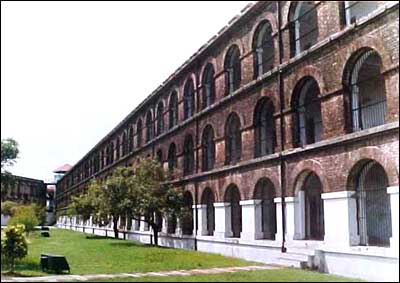
By M H AHSAN
Over 150 Indians who served various sentences in Kalapani jail during the British regime for defying the orders of the administration or rebelling against the system were invited to take part in the celebrations of the 100 years of the establishment of the Cellular Jail on March 10, 2006.
"From the unmatched sacrifices of our freedom fighters to the tyranny of our colonial rulers, from being a torture cell to a place of pilgrimage, this historical monument has come a long way since its establishment 100 years back as a penal settlement. Cellular Jail, stood mute witness to the tortures meted out to the freedom fighters, who were incarcerated in this jail," said a press handout given to mediapersons in Delhi.
It acquired the name, 'cellular' because it is entirely made up of individual cells for the solitary confinement of prisoners. It originally was a seven-pronged, puce-coloured building with a central tower and a massive structure comprising honeycomb like corridors. The building was subsequently damaged and presently only three out of seven prongs are intact. The jail, now a place of pilgrimage for all freedom-loving people, has been declared a national memorial.
Situated in Andaman, Kalapani punishment was meant to serve as a deterrent to Indian freedom fighters fighting against the British. Netaji Subash Chandra Bose hoisted the tri-colour near the cellular jail on December 30, 1943, and proclaimed independence from British rule.
It was the British-run Bengal government, and Governor General of India Lord Cornwallis, who conceived the idea of developing the Andaman Islands, in the Bay of Bengal, as a British colony in the 1700s.
Two officers – one of them was Lieutenant Archibald Blair (that's how Port Blair got its name) -- were sent to survey the area. A settlement was established on Chatham Island in a southeastern bay of the Great Andaman and was called Port Cornwallis (later its name was changed to Port Blair). There was much illness on the islands and the colony did not work out so the settlers were shipped back to the mainland.
The British government had too many prisoners on its hand, post the Mutiny of 1857 and the idea of establishing a settlement – this time a convict colony -- was revived. Some 200 prisoners were sent out initially to a jail, equipped with gallows, at Viper Island 15 minutes from Port Blair, and Kalapani was established.
The construction of Cellular Jail -- which got its name from the fact that it was made up of numerous individual cells it provided for prisoners destined for solitary confinement -- began in 1896 and was completed in 1906. The British authorities arrested hundreds of revolutionaries as more and more rebellions against the British surfaced across India. And hundreds of these prisoners were shipped out to Port Blair and were housed and ill-treated in this jail.
Veer Savarkar, many associates of Sardar Bhagat Singh, several revolutionaries of the Chittagong Revolt were some of the freedom-fighters who spent time at Cellular Jail.
The Andaman and Nicobar tourism authorities are commemorating the history of this jail with special ceremonies today.
Three surviving freedom-fighters -- Bimal Bhowmick, Kartik Sarkar and Adhir Nag -- were invited to Port Blair, as well as spouses, sons and daughters of deceased freedom fighters. There will be special functions to honour the heroes of 1857. Shubha Mudgal and Suresh Wadkar will participate in a special music programme Friday evening.
{[['']]}
']]}Data security cost skyrockets
By Shalini Mehta
Most BPOs have tripled information security budgets. Data protection — the bugbear of the business process outsourcing (BPO) industry —has in the last one year become a critical factor for the 5,000-odd BPOs whose collective revenue is estimated at $ 5.8 billion annually.
According to industry estimates, BPOs have suffered a loss of over $100 million in terms of lost business opportunity. This is around 2 per cent of the annual revenues of the industry. Most companies have re-worked their security apparatus and tripled their information security budgets.
Beginning with instances of leak of confidential financial information from Mphasis to the more recent one involving Karan Bahree, who was working for online search engine Infinity e-Search, Indian BPOs have been shrouded with controversies regarding one leak or the other in the last few months.
Indian firms are now expected to comply with the Six Sigma requirements and BS 7799 (a British standard for information security) for renewal of service contracts. "There has been a 25 per cent rise in information security spending per desktop, in the last 15 months," said Sunil Gujral, ex-CTO, Wipro Solutions.
"We had certain bad experiences after which we increased the spending on IT security from 5 percent two years back to 15 per cent of the IT budget this year," said Satish Sayal, CIO, NIIT Ltd.
The client service level deals now have specific provisions on data security. These include quarterly audits by external agency and a 'zero-violation' clause, which includes heavy penalties on breach of any security measures. "Penalties are imposed by the clients in case of violation of stipulated security measures," said R Narsimhan,CEO, HCL BPO Services.
The BPO industry, which goes in defence-mode, is more concerned with the fact every time it has to defend itself in case of any data theft.
"The security standards used in Indian BPO companies, for the work which was originally done in US or Europe, are similar or more secure," said Raman Roy, ex-CEO, Wipro Solutions.
The industry also argues that data protection issues have been blown out of proportion. "If BPOs were not secure, shouldn't some customer have raised his hand and said that Indian centres pose a data security risk? " added Roy.
The industry also counters the allegation of poor legal system. The lapses in security in smaller BPOs have also raised the issue of benchmarking the minimum standards to be adhered to by the industry.
"Most companies have their own specific standards but there are no industry-wide framework and there needs to be some kind of a set-up to ensure that basic measures are adhered to by all," said Ashish Gupta, CEO, Evalueserve. There is mounting pressure from foreign countries to put in place a stringent data protection law. "If India is going to have a world-quality BPO market, the leaks need to be plugged.... We are in talks with the Indian government for a data protection law which fits with the international norms," British High Commissioner Sir Michael Arthur said.
The government is, however, not acting yet. As per the draft IT Bill, data protection will not be mandated for BPO units.
Most BPOs have tripled information security budgets. Data protection — the bugbear of the business process outsourcing (BPO) industry —has in the last one year become a critical factor for the 5,000-odd BPOs whose collective revenue is estimated at $ 5.8 billion annually.
According to industry estimates, BPOs have suffered a loss of over $100 million in terms of lost business opportunity. This is around 2 per cent of the annual revenues of the industry. Most companies have re-worked their security apparatus and tripled their information security budgets.
Beginning with instances of leak of confidential financial information from Mphasis to the more recent one involving Karan Bahree, who was working for online search engine Infinity e-Search, Indian BPOs have been shrouded with controversies regarding one leak or the other in the last few months.
Indian firms are now expected to comply with the Six Sigma requirements and BS 7799 (a British standard for information security) for renewal of service contracts. "There has been a 25 per cent rise in information security spending per desktop, in the last 15 months," said Sunil Gujral, ex-CTO, Wipro Solutions.
"We had certain bad experiences after which we increased the spending on IT security from 5 percent two years back to 15 per cent of the IT budget this year," said Satish Sayal, CIO, NIIT Ltd.
The client service level deals now have specific provisions on data security. These include quarterly audits by external agency and a 'zero-violation' clause, which includes heavy penalties on breach of any security measures. "Penalties are imposed by the clients in case of violation of stipulated security measures," said R Narsimhan,CEO, HCL BPO Services.
The BPO industry, which goes in defence-mode, is more concerned with the fact every time it has to defend itself in case of any data theft.
"The security standards used in Indian BPO companies, for the work which was originally done in US or Europe, are similar or more secure," said Raman Roy, ex-CEO, Wipro Solutions.
The industry also argues that data protection issues have been blown out of proportion. "If BPOs were not secure, shouldn't some customer have raised his hand and said that Indian centres pose a data security risk? " added Roy.
The industry also counters the allegation of poor legal system. The lapses in security in smaller BPOs have also raised the issue of benchmarking the minimum standards to be adhered to by the industry.
"Most companies have their own specific standards but there are no industry-wide framework and there needs to be some kind of a set-up to ensure that basic measures are adhered to by all," said Ashish Gupta, CEO, Evalueserve. There is mounting pressure from foreign countries to put in place a stringent data protection law. "If India is going to have a world-quality BPO market, the leaks need to be plugged.... We are in talks with the Indian government for a data protection law which fits with the international norms," British High Commissioner Sir Michael Arthur said.
The government is, however, not acting yet. As per the draft IT Bill, data protection will not be mandated for BPO units.
{[['']]}
']]}FILM REVIEW: PYARE MOHAN (HINDI) ***
 By M H AHSAN
Vivek Oberoi and Fardeen Khan starrer Pyare Mohan lacks the punch of a comedy film. Directed by Indra Kumar, the movie stars Fardeen Khan , Vivek Oberoi , Esha Deol , Amrita Rao and Boman Irani .
Given the movie’s basic story idea, ‘Pyare Mohan’ could have been an interesting flick. Two friends – one blind and the other deaf – go about their lives with fun and masti without letting their handicap become a weakness.
They also fall in love and later on fight the bad guys to save their sweethearts. Pyare (Fardeen Khan) is blind as a bat. Day or night, light or darkness makes no difference to him. He goes on morning walks, reads the newspaper upside down and can sense a man’s intention despite his inability to see.Mohan (Vivek Oberoi) needs just an excuse to break into dance at the slightest opportunity. He is deaf and can’t hear a damn thing, but he shakes his leg to the music, be it a marriage ceremony or (mistakenly) a funeral procession.
Together, Pyare and Mohan are inseparable friends running an Archies shop. But there is something lacking in their lives. It is love.Cupid strikes when the two meet Priya (Amrita Rao) and Preeti (Esha Deol) during a morning walk. While Pyare is smitten with Preeti, Mohan loses his heart to Priya.Preeti and Priya perform at musical shows. Their friendship with Pyare and Mohan cements after the two heroes help them during a concert.
But when Pyare and Mohan express their love to Preeti and Priya, their proposal is turned down. Preeti and Priya admit that they have always seen Pyare and Mohan as good friends but they don’t have any romantic feelings for them. Pyare and Mohan are shattered.Post interval, the two girls get into trouble in Bangkok where they are arrested for a murder. Not only this, an underworld don Tony (Boman Irani) wants to kill them.In this hour of need, Preeti and Priya’s dear ones turn their back to them. Only the blind Pyare and the deaf Mohan, whose love the two belles had rebuked earlier, come to their rescue. What follows is a cat-and-mouse game in which our blind and deaf heroes excel over the baddies.
Indra Kumar , the movie’s director, showed an incredible command over comedy in his movie Masti two years ago. But he disappoints in ‘Pyare Mohan’. Barring a few sequences, the humour in ‘Pyare Mohan’ is pretty mundane.
Vivek Oberoi does evoke a few chuckles in some scenes. His very opening scene, when he is dancing in a marriage and unknowingly starts dancing in front of a funeral along side, is funny. Also the look he wears throughout the movie, reading the lips of people speaking to him, gives his character a hilarious touch.Fardeen Khan looks handsome, but doesn’t impress in comedy.
There are certain scenes in which his expressions are plain wooden.Esha Deol and Amrita Rao react more than act in the movie. Boman Irani is just about ok, playing a stuttering don, who claims his victims with a baseball bat.To sum it up, ‘Pyare Mohan’ had the potential to be an entertaining comedy. But the writers have not been able to do justice to the script. The humour in the movie is obviously predictable and absurdly puerile.
{[['']]}
']]}INDIA GOSSIPS NETWORK
I N D I A G O S S I P
INDIAGOSS is an online e-newspaper with a difference. On a mission, with a vision, to put the records straight...on all counts. It arrives on the scene of India's Journalism not as a meek follower of somebody or as a potent 'power' with a solid financial or political backup to fulfill its material goals.
INDIAGOSS is an accredited online gossip news network, it's news blend aesthetics with contents, character and maturity, setting the new standards in Indian events, happenings and issues treated with sensitivity and intelligence. It fight for the causes of Indians living across the world. It speaks the language of liberty, justice and quality.
INDIAGOSS is a comprehensive gossip news portal, updates several times in a day with its latest technology and wide network and most powerful expertise. This portal will give you latest, unreported, unpublished, juicy and informative 'all gossip news' in every walk of life, everyday. Each of our update delivers authoritative reporting and analysis of the India's most important news and events. Our news gathering resources means that you'll get the big picture -- a unique perspective, access to newsmakers and incisive coverage that helps web readers prepare for tomorrow by developing understanding on what is happening today.
'INDIAGOSS' marking its beginning with a difference.
{[['']]}
']]}Look to helpline, land in jail
Those turning to the Government 'helpline' in Mahbubnagar, Andhra Pradesh, learn the hard way what happens when the little farmer of the countryside runs into the large apparatus of the state. P Sainath reports on a farmer's near-death brush with the government's promise of relief.
When Boya Madhiletti approached the Andhra Pradesh Government's 'helpline', the bankrupt farmer never thought it would land him in hospital and even jail. Madhiletti, 29, went by the advice of well-meaning neighbours. "There is an official helpline for farmers in distress," they told him. "So even if you are deep in debt, do nothing rash. Contact the helpline and they will do something."
So he did. Mr. Madhiletti's brush with the helpline - which saw a revenue inspector harass him for a bribe - convinced him that suicide was the only way out. The indebted farmer tried killing himself right at the Collectorate in Mahbubnagar. He failed and wound up paying thousands of rupees in hospital costs. And the man who had gone to the helpline for aid, languished in jail on the charge of attempted suicide until his hard-up village took out a collection and raised bail for him.
The day he decided to kill himself, Mr. Madhiletti walked into the Red Cross Centre at Mahbubnagar town - to donate blood. "I thought if I am going to end my life, let someone benefit from it," he told us at his home in Rajouli village. "The Red Cross people said 'we can't give you money for your blood.' That made me angry since I had not asked for any. I told them I was not doing it for payment. So they took my offer." He shows us the certificate dated August 11, 2005, confirming his blood donation.
"All I wanted from the Government was help with a bank loan. My family has 12 acres, after all, and surely we should get a loan against that land? But we could not." He is the eldest son in a family of 12.
"I tried for months to meet the officials and tell them of my problems," says Mr. Madhiletti. Rising costs and crop failure in successive seasons had left him Rs.3 lakh in debt. This Mahbubnagar farmer grows sunflower, cotton, and maize. He also supplies seed to a private corporation. "The company gives us some advance money, towards input costs, through a middleman," says a neighbour. "Our risks are high, but the losses are never shared by the company or the middlemen." For Mr. Madhiletti, those losses just got too much. He had also spent close to Rs.3 lakh on two borewells and a pipeline.
"I approached the Chief Minister with a petition," he says. "He said he was handing over my plea to the District Collector and I should follow up there. I did, but it seemed impossible to meet anybody." Meanwhile, his debts were mounting and so was pressure from the middlemen. At one point, he says, he even saw the Collector. But "he did not speak. And I had no chance to explain." Nor was accessing other officers any easier.
After some weeks of this, when he was really depressed, the helpline idea came up. That was set up in 2004 by the newly elected Congress Government. Andhra Pradesh had witnessed thousands of distress suicides by indebted farmers since 1998. The idea was to counsel, advise, and assist farmers, and to stop them from taking the extreme step.
"Finally I got through to the MRO [Mandal Revenue Office]," says Mr. Madhiletti. "I was told a Revenue Inspector would enquire into my case. What is there to enquire, I asked. I am just seeking a bank loan and you can see my documents of land ownership right here."
"Next, the revenue inspector called me and asked me for a bribe. He said: 'if you want a report in your favour without any fuss, pay me Rs.2,000.' As simple as that." Mr. Madhiletti did not pay the bribe. "While I was out of town for a day, the RI went ahead and made the visit."
"Firstly," says Mr. Madhiletti, "my family did not want that sort of public exposure of our troubles." More importantly, "that visit of the officer scared off all potential creditors. Those who might have loaned me something now would not." The bribe demand and all that followed it drove the farmer over the edge. "I tried meeting the Collector again, but failed. I also went to the Red Cross and gave blood."
Mr. Madhiletti returned to the Collectorate and waited hours but was still unable to meet anyone. That was when he consumed the pesticide he had bought the same day. After an attender at the office found him lying in agony, he was bundled into a car and rushed to the Nizam Institute of Medical Sciences (NIMS) in Hyderabad some 100 km away. All this was done in a matter of hours by officials who had had no time to meet him in months. "One officer went all the way to Hyderabad with him," says a neighbour.
"He spent nearly two weeks at NIMS," says his father Easwaranna. "The costs came to over Rs.10,000." Mr. Madhiletti came home on August 23. The distraught farmer had not yet recovered from his ordeal when the police showed up at his door and booked him for attempted suicide. "I spent one night at the station and was produced the next morning in court," he says. He then went to jail for about 15 days. He might have stayed in longer since he had no money for bail. "But we got together a collection and helped him out," say his neighbours.
So Mr. Madhiletti emerged from jail thanks to the few thousand rupees put up by his friends. He's been summoned to court twice since then. "But each time, the case was adjourned without a hearing. The last date was January 7 this year." He again failed to meet the Collector. But after news of the event spread, officials ensured he got a bank loan of Rs.20,000 at eight per cent interest.
The villagers, though, have drawn a bleak lesson from this saga of a little farmer and the mighty apparatus of state. "From their point of view," says a local journalist, "none of this would have happened if he had paid that bribe of Rs.2,000. He would have had no problem." But Mr. Madhiletti has little time for reflection. He has to fulfil his contract with an unsparing seed company.
About the writer: P Sainath is one of the two recipients of the A.H. Boerma Award, 2001, granted for his contributions in changing the nature of the development debate on food, hunger and rural development in the Indian media.
When Boya Madhiletti approached the Andhra Pradesh Government's 'helpline', the bankrupt farmer never thought it would land him in hospital and even jail. Madhiletti, 29, went by the advice of well-meaning neighbours. "There is an official helpline for farmers in distress," they told him. "So even if you are deep in debt, do nothing rash. Contact the helpline and they will do something."
So he did. Mr. Madhiletti's brush with the helpline - which saw a revenue inspector harass him for a bribe - convinced him that suicide was the only way out. The indebted farmer tried killing himself right at the Collectorate in Mahbubnagar. He failed and wound up paying thousands of rupees in hospital costs. And the man who had gone to the helpline for aid, languished in jail on the charge of attempted suicide until his hard-up village took out a collection and raised bail for him.
The day he decided to kill himself, Mr. Madhiletti walked into the Red Cross Centre at Mahbubnagar town - to donate blood. "I thought if I am going to end my life, let someone benefit from it," he told us at his home in Rajouli village. "The Red Cross people said 'we can't give you money for your blood.' That made me angry since I had not asked for any. I told them I was not doing it for payment. So they took my offer." He shows us the certificate dated August 11, 2005, confirming his blood donation.
"All I wanted from the Government was help with a bank loan. My family has 12 acres, after all, and surely we should get a loan against that land? But we could not." He is the eldest son in a family of 12.
"I tried for months to meet the officials and tell them of my problems," says Mr. Madhiletti. Rising costs and crop failure in successive seasons had left him Rs.3 lakh in debt. This Mahbubnagar farmer grows sunflower, cotton, and maize. He also supplies seed to a private corporation. "The company gives us some advance money, towards input costs, through a middleman," says a neighbour. "Our risks are high, but the losses are never shared by the company or the middlemen." For Mr. Madhiletti, those losses just got too much. He had also spent close to Rs.3 lakh on two borewells and a pipeline.
"I approached the Chief Minister with a petition," he says. "He said he was handing over my plea to the District Collector and I should follow up there. I did, but it seemed impossible to meet anybody." Meanwhile, his debts were mounting and so was pressure from the middlemen. At one point, he says, he even saw the Collector. But "he did not speak. And I had no chance to explain." Nor was accessing other officers any easier.
After some weeks of this, when he was really depressed, the helpline idea came up. That was set up in 2004 by the newly elected Congress Government. Andhra Pradesh had witnessed thousands of distress suicides by indebted farmers since 1998. The idea was to counsel, advise, and assist farmers, and to stop them from taking the extreme step.
"Finally I got through to the MRO [Mandal Revenue Office]," says Mr. Madhiletti. "I was told a Revenue Inspector would enquire into my case. What is there to enquire, I asked. I am just seeking a bank loan and you can see my documents of land ownership right here."
"Next, the revenue inspector called me and asked me for a bribe. He said: 'if you want a report in your favour without any fuss, pay me Rs.2,000.' As simple as that." Mr. Madhiletti did not pay the bribe. "While I was out of town for a day, the RI went ahead and made the visit."
"Firstly," says Mr. Madhiletti, "my family did not want that sort of public exposure of our troubles." More importantly, "that visit of the officer scared off all potential creditors. Those who might have loaned me something now would not." The bribe demand and all that followed it drove the farmer over the edge. "I tried meeting the Collector again, but failed. I also went to the Red Cross and gave blood."
Mr. Madhiletti returned to the Collectorate and waited hours but was still unable to meet anyone. That was when he consumed the pesticide he had bought the same day. After an attender at the office found him lying in agony, he was bundled into a car and rushed to the Nizam Institute of Medical Sciences (NIMS) in Hyderabad some 100 km away. All this was done in a matter of hours by officials who had had no time to meet him in months. "One officer went all the way to Hyderabad with him," says a neighbour.
"He spent nearly two weeks at NIMS," says his father Easwaranna. "The costs came to over Rs.10,000." Mr. Madhiletti came home on August 23. The distraught farmer had not yet recovered from his ordeal when the police showed up at his door and booked him for attempted suicide. "I spent one night at the station and was produced the next morning in court," he says. He then went to jail for about 15 days. He might have stayed in longer since he had no money for bail. "But we got together a collection and helped him out," say his neighbours.
So Mr. Madhiletti emerged from jail thanks to the few thousand rupees put up by his friends. He's been summoned to court twice since then. "But each time, the case was adjourned without a hearing. The last date was January 7 this year." He again failed to meet the Collector. But after news of the event spread, officials ensured he got a bank loan of Rs.20,000 at eight per cent interest.
The villagers, though, have drawn a bleak lesson from this saga of a little farmer and the mighty apparatus of state. "From their point of view," says a local journalist, "none of this would have happened if he had paid that bribe of Rs.2,000. He would have had no problem." But Mr. Madhiletti has little time for reflection. He has to fulfil his contract with an unsparing seed company.
About the writer: P Sainath is one of the two recipients of the A.H. Boerma Award, 2001, granted for his contributions in changing the nature of the development debate on food, hunger and rural development in the Indian media.
{[['']]}
']]}Saturday, April 22, 2006
Information as empowerment
Conceived as an anti-poverty effort, the Navodayam project in Andhra Pradesh has grown with government support into a full-fledged media entity taking up coverage of serious local issues. Its members see themselves playing a vital role, and making a difference to the lives of lakhs of women in their districts. Shoma Chatterji reports.
Six poor and semi-educated women living in Chittoor district in Tirupathy gather, write, edit, lay out, print, publish and distribute a newspaper in Telugu all by themselves. Picking and laying out photographs, running a cartoon strip - by one member of the staff who happens to be a good artist - are also all par for the course these young women have set themselves. Their lives, they say, have changed since they began to work on the Navodayam project, aimed at empowering women through communication. Their efforts to take the newspaper to the villages, part of the World Bank's Poverty Alleviation Programme, began in August 2001 and has turned some important pages in development since then.
The four major aims Navodayam has laid out for itself are – (a) to amplify the voice of the rural poor, (b) to put rural women in charge of news coverage, (c) to place information within the reach of the rural poor, and (d) to adapt journalism as a tool for empowerment of women. "Covering and reporting news is an act of empowerment," says Manjula, who edits the newsletter. "It began as a quarterly newsletter but with rising demand we increased the periodicity to a monthly, and 31 issues have come out by the end of 2005." They printed only 750 copies for the inaugural issue. Today, nearly 30,000 copies are printed, and all are sold out. 80 reporters, all of them from poor families settled in rural areas, have learnt reporting, writing, editing and layout since the newsletter came out. At present, Navodayam has 12 working reporters and 20 contributors. Navodayam's area of news reporting initially covered 10 mandals in Chittoor but now it covers the entire district.
Though the project is totally sponsored by the government, the women involved with the newsletter have been able to retain their independence and there is no editorial interference from the government. Strangely, however, support has been less forthcoming from fellow professionals in the media itself.
"I am aggrieved to say that the Andhra Pradesh Union of Working Journalists has been denying membership to Navodayam because the APWJ feels that this is a government paper, never mind how much we insist that we are independent in every way, the sponsorship from the government notwithstanding," laments Manjula. "Our reporters are semi-literate and poor women from the villages. They have undergone training in newsgathering and filing copy. We have also picked out the artists among them. We have put them through basic training in journalism that has improved their language, writing and editing skills. They have been so effective that they have acquired the courage and integrity needed to deal with the consequences of conscientious reporting and critical writing," she informs.
Mallika, a member of the core group of six women, says that they have also received death threats for covering issues directly dealing with local women from vested interests who do not want Navodayam to deal with the problems of local women. "We bring out a special issue on the basis of a survey we conduct ourselves. We publish our findings in the form of a report in an issue. We also approach the local collector, ask him for his views and publish his side of the story as well. In this way, we move one step ahead of news. For example, we went to cover four cases of the rape of four girls. We discovered that in one of these, a 14-year-old girl had been raped by a 50-year-old man and had left school for the social stigma the rape created. We not only brought pressure on the perpetrator but also persuaded the girl to get back to school," recounts Mallika.
Since the electronic media takes its own time to reach the village population, Navodayam has trained two of its workers in videography and video documentation in a six-week training programme. They made a video film on child marriage – rampant in some pockets – and showed this to the villagers. They once did a survey of four child marriages. In one of these, the girl was just five years old and her husband died a month after the marriage. This was included in the video film and they showed it to the local collector. Women of self-help groups who have taken their children out of school to join in the long queue of child labour have been persuaded by the Navodayam women to bring the children back from their labour camps and put them back to school.
"There was one touching case of a woman who committed suicide and we brought this to public view by writing about it. It happened because the woman had taken a loan from an NGO that offered micro loans to rural women. But the woman did not know anything about the interest payable on the loan. So, when she saw the interest that had accumulated after some time, she was shocked and this drove her to suicide. Our aim was to drive home the point that since village women were illiterate, all details needed to be spelt out for them in the future so that such tragic cases did not happen again," Manjula elaborates.
"We publish at least one article on HIV-AIDS-related issues every month. But all this does not necessarily mean that our focus is on problems alone. We also focus on positive and inspiring stories. One such story was on the achievements and successes of single women," adds Mallika. These women also interview old men and women to highlight traditional practices in life, health, food, child-birth practices and so on that are now forgotten in order to remain rooted to the culture "because the electronic media in general does not bother about the rural population much," quips Manjula.
The women have faced and overcome problems from the liquor lobby, from defaulters of government loan schemes, and sometimes even from government officials. Five of the six women who man the editorial board of Navodayam are going to graduate from Open University. Some of them also string for mainstream publications in Andhra Pradesh and self-help groups have come to rely on Navodayam as a trustworthy partner in conflict-resolution. Navodayam has received the prestigious Best Rural Women Journalists Award for 2005 from the Data News Features at Hyderabad. The Navodayam model has now been emulated by Self-Help Groups and eight newsletters have started in eight different districts of Andhra Pradesh. Today, 30,000 Self-Help Groups subscribe to Navodayam and its readership extends to a staggering three lakhs.
The work is divided into two segments. For 20 days, the women and their reporting team are out collecting and gathering news, conducting interviews and surveys and distributing issues of Navodayam. The remaining 10 days are spent in the office – now equipped with a computerized outfit – laying out, editing, proof-reading, page-making, printing the paper and getting it ready for distribution. Each of the six core women draw a monthly salary of Rs.1500 which is paltry by urban standards but not when compared to their earlier economic state. Manjula says that she was allergic to reading the newspaper. Then she became part of Navodayam's reporting team and in nine months, she became the editor of the paper. Her husband initially opposed her decision to become a journalist. "I made him sit at one of our meetings from morning till night and that convinced him," says Manjula. He passed away soon after and she now is a single mother with children to be taken care of and a newsletter to edit.
"I feel very proud when I realize that I have made a difference to the lives of lakhs of women in my district. I am very happy being a journalist and do not want to do anything else," she sums up. Mallika adds that although she is not educated, or city-bred or sophisticated or can speak English, she has taken up been quite successful as a journalist, taking up investigative stories that have been commented and acted upon by local district collectors. She has been at the receiving end of death threats, she notes. But having overcome these obstacles has led her to believe in herself and in the journalism she can do. "In fact, it is very easy," she adds modestly.
Six poor and semi-educated women living in Chittoor district in Tirupathy gather, write, edit, lay out, print, publish and distribute a newspaper in Telugu all by themselves. Picking and laying out photographs, running a cartoon strip - by one member of the staff who happens to be a good artist - are also all par for the course these young women have set themselves. Their lives, they say, have changed since they began to work on the Navodayam project, aimed at empowering women through communication. Their efforts to take the newspaper to the villages, part of the World Bank's Poverty Alleviation Programme, began in August 2001 and has turned some important pages in development since then.
The four major aims Navodayam has laid out for itself are – (a) to amplify the voice of the rural poor, (b) to put rural women in charge of news coverage, (c) to place information within the reach of the rural poor, and (d) to adapt journalism as a tool for empowerment of women. "Covering and reporting news is an act of empowerment," says Manjula, who edits the newsletter. "It began as a quarterly newsletter but with rising demand we increased the periodicity to a monthly, and 31 issues have come out by the end of 2005." They printed only 750 copies for the inaugural issue. Today, nearly 30,000 copies are printed, and all are sold out. 80 reporters, all of them from poor families settled in rural areas, have learnt reporting, writing, editing and layout since the newsletter came out. At present, Navodayam has 12 working reporters and 20 contributors. Navodayam's area of news reporting initially covered 10 mandals in Chittoor but now it covers the entire district.
Though the project is totally sponsored by the government, the women involved with the newsletter have been able to retain their independence and there is no editorial interference from the government. Strangely, however, support has been less forthcoming from fellow professionals in the media itself.
"I am aggrieved to say that the Andhra Pradesh Union of Working Journalists has been denying membership to Navodayam because the APWJ feels that this is a government paper, never mind how much we insist that we are independent in every way, the sponsorship from the government notwithstanding," laments Manjula. "Our reporters are semi-literate and poor women from the villages. They have undergone training in newsgathering and filing copy. We have also picked out the artists among them. We have put them through basic training in journalism that has improved their language, writing and editing skills. They have been so effective that they have acquired the courage and integrity needed to deal with the consequences of conscientious reporting and critical writing," she informs.
Mallika, a member of the core group of six women, says that they have also received death threats for covering issues directly dealing with local women from vested interests who do not want Navodayam to deal with the problems of local women. "We bring out a special issue on the basis of a survey we conduct ourselves. We publish our findings in the form of a report in an issue. We also approach the local collector, ask him for his views and publish his side of the story as well. In this way, we move one step ahead of news. For example, we went to cover four cases of the rape of four girls. We discovered that in one of these, a 14-year-old girl had been raped by a 50-year-old man and had left school for the social stigma the rape created. We not only brought pressure on the perpetrator but also persuaded the girl to get back to school," recounts Mallika.
Since the electronic media takes its own time to reach the village population, Navodayam has trained two of its workers in videography and video documentation in a six-week training programme. They made a video film on child marriage – rampant in some pockets – and showed this to the villagers. They once did a survey of four child marriages. In one of these, the girl was just five years old and her husband died a month after the marriage. This was included in the video film and they showed it to the local collector. Women of self-help groups who have taken their children out of school to join in the long queue of child labour have been persuaded by the Navodayam women to bring the children back from their labour camps and put them back to school.
"There was one touching case of a woman who committed suicide and we brought this to public view by writing about it. It happened because the woman had taken a loan from an NGO that offered micro loans to rural women. But the woman did not know anything about the interest payable on the loan. So, when she saw the interest that had accumulated after some time, she was shocked and this drove her to suicide. Our aim was to drive home the point that since village women were illiterate, all details needed to be spelt out for them in the future so that such tragic cases did not happen again," Manjula elaborates.
"We publish at least one article on HIV-AIDS-related issues every month. But all this does not necessarily mean that our focus is on problems alone. We also focus on positive and inspiring stories. One such story was on the achievements and successes of single women," adds Mallika. These women also interview old men and women to highlight traditional practices in life, health, food, child-birth practices and so on that are now forgotten in order to remain rooted to the culture "because the electronic media in general does not bother about the rural population much," quips Manjula.
The women have faced and overcome problems from the liquor lobby, from defaulters of government loan schemes, and sometimes even from government officials. Five of the six women who man the editorial board of Navodayam are going to graduate from Open University. Some of them also string for mainstream publications in Andhra Pradesh and self-help groups have come to rely on Navodayam as a trustworthy partner in conflict-resolution. Navodayam has received the prestigious Best Rural Women Journalists Award for 2005 from the Data News Features at Hyderabad. The Navodayam model has now been emulated by Self-Help Groups and eight newsletters have started in eight different districts of Andhra Pradesh. Today, 30,000 Self-Help Groups subscribe to Navodayam and its readership extends to a staggering three lakhs.
The work is divided into two segments. For 20 days, the women and their reporting team are out collecting and gathering news, conducting interviews and surveys and distributing issues of Navodayam. The remaining 10 days are spent in the office – now equipped with a computerized outfit – laying out, editing, proof-reading, page-making, printing the paper and getting it ready for distribution. Each of the six core women draw a monthly salary of Rs.1500 which is paltry by urban standards but not when compared to their earlier economic state. Manjula says that she was allergic to reading the newspaper. Then she became part of Navodayam's reporting team and in nine months, she became the editor of the paper. Her husband initially opposed her decision to become a journalist. "I made him sit at one of our meetings from morning till night and that convinced him," says Manjula. He passed away soon after and she now is a single mother with children to be taken care of and a newsletter to edit.
"I feel very proud when I realize that I have made a difference to the lives of lakhs of women in my district. I am very happy being a journalist and do not want to do anything else," she sums up. Mallika adds that although she is not educated, or city-bred or sophisticated or can speak English, she has taken up been quite successful as a journalist, taking up investigative stories that have been commented and acted upon by local district collectors. She has been at the receiving end of death threats, she notes. But having overcome these obstacles has led her to believe in herself and in the journalism she can do. "In fact, it is very easy," she adds modestly.
{[['']]}
']]}Through the eyes of women filmmakers
"Women, Media and Transformations" was the leitmotif of a festival of documentary and short films for South Asian women filmmakers that concluded in Calcutta earlier this month. Shoma Chatterji was there and writes that the films offered a wide spectrum of subjects from ethnographic investigation to introspective, abstract journeys.
"Creative treatment of actuality" was John Grierson's definition of the documentary. "The essence of cinema is its ability to transport the viewer to a different plane. The genius of cinema is contained in the process of cinema: the act of filming itself is what contains the potential to create art, for it is here that one can articulate this relation of the maker to the subject and to the spectator," said Dennis O'Rourke, the noted Australian documentary maker, about the non-fiction film. The act of creating a documentary film is one of synthesis upon synthesis, in the same way that, for a novelist, writing is re-writing. The 26 films screened at the recently concluded (1-3 April) festival of films in Calcutta substantiate this statement from the point of view of women filmmakers from South Asia.
"Women, Media and Transformations" was the leitmotif of this festival, which began in Delhi, moved on to Ahmedabad and from there to Calcutta. The International Association of Women in Radio and Television (IAWRT) presented the festival in Calcutta in collaboration with Nandan, the cultural complex owned by the state government of West Bengal. Of the 26 films, 18 were made by Indian filmmakers based in India whereas the rest were from Malaysia, Canada, UK - made by Indian women based abroad. Complementing the film festival was a poster exhibition on violence against women, and three workshops on different aspects of cinema and television, organised by Swayam, a Calcutta-based NGO.
"The personal is political" appears to be the underpinning layer for celluloid statements by women filmmakers across the world. While the festival offered a wide spectrum of subjects from ethnographic investigation to introspective, abstract journeys, most of the films chosen reflected an inclination for nostalgia, memories, relationships and the schisms within. Few, one must confess, ventured into broad-based narratives addressing larger issues, which, interestingly, instead of narrowing the focus, led to the raising of larger questions. Short fiction rubbed shoulders with the documentary.
If the festival were to be competitive, which, thankfully, it was not, the prize would have unquestionably gone to Gitanjali Rao's animation film Printed Rainbow. It is a beautiful story of a lonely old woman's life with her cat and the old man living opposite her home. The old lady finds escape in a colourful world of daydreams through flights of fantasy into adventure from her collection of matchbox labels. The next best film in the festival was Parvinder Kaur's Will Think of Food a personal statement by the director who faces a mental block while being commissioned to make a commercial on food without money, of course! It is a hilarious take on the entire process of filmmaking itself, and on the struggles of the lay filmmaker desperately trying to strike out on her own.
Beyond the Wheel, by Rajula Shah, is a documentary that fluidly encapsulates the interaction between and among three noted, contemporary women potters distanced by region, language, religion and culture. The film offers interesting light on how the conventional taboo on the woman not permitted to touch the potter's wheel is circumvented by the two older women, one from Gujarat and the other from Manipur. The easy camaraderie creates a bonding that is articulated without being stated. She Write, by Anjali Monteiro and K P Jayshankar journeys through the works and struggles of four Tamil women poets, Salma, Kuttirevathi, Malathy Maitri and Sukirtharani. They are constantly the target of attack by men script writers in Tamil for their generous use of four-letter words and what these men term 'vulgar' imagery. But they refuse to be bogged down by these attacks and continue to write how they will, what they will.
Altar, by Leena Manimekalai sheds light on the rigid mindset of the Kambalathu Naicker community in Tamil Nadu. It is an ethnographic investigation with metaphorical interventions of the famous cattle fair in the area. The Naickers follow strange customs of child marriage for both boys and girls. Girls are often married to brothers of the same family and are permitted to sleep with any of them. It never occurs to the girls to question these age-old customs that do not have the sanction of law. The narrative however, tends to get diluted with too many interventions of the cattle fair.
Monisha Baldawa's Lemon Yellow Afternoons explores an evolving relationship between an ageing Tamil housewife and Chinu, a little Maharastrian girl, her neighbour in a Pune chawl, and how the older woman draws the energy to go on with the dreary routine of being a housewife from the little girl's vibrancy and innocence. Paromita Vohra's Where's Sandra is a light-hearted look at the Bandra-ka-Sandra motif Mumbaiyites are very familiar with. Vohra interviews a cross-section of women all of whom are named Sandra. They laugh at the jokes about their predecessors' mode of dressing and hold over Mumbai's secretarial jobs. Celebrity Bandraites scoff at arbitrary value judgements made on the morals of the girls. (In earlier times, secretarial jobs in Mumbai were mostly filled by Christian women in general and from Bandra in particular, because Bandra had a large Christian pocket.)
Kavitha Joshi's presentation, Untitled: Three Films from Manipur essays three stories of the strife of civilians, especially women of Manipur, hanging on the last dredges of life, thanks to the Armed Forces Special Powers Act 1958. She also captures the deep-seated resentment among women leading to unceasing protest, including images of the valiant Sharmila who has been on a fast for about five years. The governments at the Centre and State levels have remained unmoved by Sharmila's fast.
Walking On A Moonbeam directed by Madhureeta Anand is a fictionalised account of a woman whose sleepless nights continue to be haunted by memories of sexual abuse as a little girl, resulting in bed-wetting. But the film fails to come across lucidly because of a rather confused and convoluted narrative aided by the same actress playing the role of mother and daughter. Reena Mohan, whose films earlier bagged international awards, fails to do justice to herself and to the medium of her choice through On an Express Highway, tracing the journey of a 33-year-old woman who voluntarily gave up the material world to become a Jain sadhvi.
For Maya, Vasudha Joshi's directorial debut, is her perspective on gender, as reflected through the personal histories of her mother, sister, daughter and herself. The rich tapestry of Ranjan Palit's brilliant cinematography that effectively captures chiaroscuro* in colour enriches the narrative.
A number of films screened are too personal to appeal to a larger audience and do not either inform, or educate, much less, entertain: Dipti M Panesar's Biji: A Documentary on My Grandmother, Samina Mishra's The House on Gulmohar Avenue and Rita Chandel's The Journey. Those films apart, Our Own Eyes (Ranu Sharma) and Trans (Tejal Shah) are abstractions that are commendable for the filmmakers' daring to experiment and explore new forms within the documentary and short-fiction format.
The common element that binds these women filmmakers is that they try to place their emotional perspective within a social process, which sometimes evolves into a strong political statement and sometimes does not. Wigan & Leigh, Drik-India, NEXGEN School of Management and Technology and Swayam supported the festival as co-sponsors.
About the writer: Shoma Chatterji is a freelance writer based in Kolkata, and a member of NWMI. She is the author of 16 books, including 'Kali - The Goddess of Kolkota' and 'Gender and Conflict', which were both released at this year's Calcutta Book Fair.
"Creative treatment of actuality" was John Grierson's definition of the documentary. "The essence of cinema is its ability to transport the viewer to a different plane. The genius of cinema is contained in the process of cinema: the act of filming itself is what contains the potential to create art, for it is here that one can articulate this relation of the maker to the subject and to the spectator," said Dennis O'Rourke, the noted Australian documentary maker, about the non-fiction film. The act of creating a documentary film is one of synthesis upon synthesis, in the same way that, for a novelist, writing is re-writing. The 26 films screened at the recently concluded (1-3 April) festival of films in Calcutta substantiate this statement from the point of view of women filmmakers from South Asia.
"Women, Media and Transformations" was the leitmotif of this festival, which began in Delhi, moved on to Ahmedabad and from there to Calcutta. The International Association of Women in Radio and Television (IAWRT) presented the festival in Calcutta in collaboration with Nandan, the cultural complex owned by the state government of West Bengal. Of the 26 films, 18 were made by Indian filmmakers based in India whereas the rest were from Malaysia, Canada, UK - made by Indian women based abroad. Complementing the film festival was a poster exhibition on violence against women, and three workshops on different aspects of cinema and television, organised by Swayam, a Calcutta-based NGO.
"The personal is political" appears to be the underpinning layer for celluloid statements by women filmmakers across the world. While the festival offered a wide spectrum of subjects from ethnographic investigation to introspective, abstract journeys, most of the films chosen reflected an inclination for nostalgia, memories, relationships and the schisms within. Few, one must confess, ventured into broad-based narratives addressing larger issues, which, interestingly, instead of narrowing the focus, led to the raising of larger questions. Short fiction rubbed shoulders with the documentary.
If the festival were to be competitive, which, thankfully, it was not, the prize would have unquestionably gone to Gitanjali Rao's animation film Printed Rainbow. It is a beautiful story of a lonely old woman's life with her cat and the old man living opposite her home. The old lady finds escape in a colourful world of daydreams through flights of fantasy into adventure from her collection of matchbox labels. The next best film in the festival was Parvinder Kaur's Will Think of Food a personal statement by the director who faces a mental block while being commissioned to make a commercial on food without money, of course! It is a hilarious take on the entire process of filmmaking itself, and on the struggles of the lay filmmaker desperately trying to strike out on her own.
Beyond the Wheel, by Rajula Shah, is a documentary that fluidly encapsulates the interaction between and among three noted, contemporary women potters distanced by region, language, religion and culture. The film offers interesting light on how the conventional taboo on the woman not permitted to touch the potter's wheel is circumvented by the two older women, one from Gujarat and the other from Manipur. The easy camaraderie creates a bonding that is articulated without being stated. She Write, by Anjali Monteiro and K P Jayshankar journeys through the works and struggles of four Tamil women poets, Salma, Kuttirevathi, Malathy Maitri and Sukirtharani. They are constantly the target of attack by men script writers in Tamil for their generous use of four-letter words and what these men term 'vulgar' imagery. But they refuse to be bogged down by these attacks and continue to write how they will, what they will.
Altar, by Leena Manimekalai sheds light on the rigid mindset of the Kambalathu Naicker community in Tamil Nadu. It is an ethnographic investigation with metaphorical interventions of the famous cattle fair in the area. The Naickers follow strange customs of child marriage for both boys and girls. Girls are often married to brothers of the same family and are permitted to sleep with any of them. It never occurs to the girls to question these age-old customs that do not have the sanction of law. The narrative however, tends to get diluted with too many interventions of the cattle fair.
Monisha Baldawa's Lemon Yellow Afternoons explores an evolving relationship between an ageing Tamil housewife and Chinu, a little Maharastrian girl, her neighbour in a Pune chawl, and how the older woman draws the energy to go on with the dreary routine of being a housewife from the little girl's vibrancy and innocence. Paromita Vohra's Where's Sandra is a light-hearted look at the Bandra-ka-Sandra motif Mumbaiyites are very familiar with. Vohra interviews a cross-section of women all of whom are named Sandra. They laugh at the jokes about their predecessors' mode of dressing and hold over Mumbai's secretarial jobs. Celebrity Bandraites scoff at arbitrary value judgements made on the morals of the girls. (In earlier times, secretarial jobs in Mumbai were mostly filled by Christian women in general and from Bandra in particular, because Bandra had a large Christian pocket.)
Kavitha Joshi's presentation, Untitled: Three Films from Manipur essays three stories of the strife of civilians, especially women of Manipur, hanging on the last dredges of life, thanks to the Armed Forces Special Powers Act 1958. She also captures the deep-seated resentment among women leading to unceasing protest, including images of the valiant Sharmila who has been on a fast for about five years. The governments at the Centre and State levels have remained unmoved by Sharmila's fast.
Walking On A Moonbeam directed by Madhureeta Anand is a fictionalised account of a woman whose sleepless nights continue to be haunted by memories of sexual abuse as a little girl, resulting in bed-wetting. But the film fails to come across lucidly because of a rather confused and convoluted narrative aided by the same actress playing the role of mother and daughter. Reena Mohan, whose films earlier bagged international awards, fails to do justice to herself and to the medium of her choice through On an Express Highway, tracing the journey of a 33-year-old woman who voluntarily gave up the material world to become a Jain sadhvi.
For Maya, Vasudha Joshi's directorial debut, is her perspective on gender, as reflected through the personal histories of her mother, sister, daughter and herself. The rich tapestry of Ranjan Palit's brilliant cinematography that effectively captures chiaroscuro* in colour enriches the narrative.
A number of films screened are too personal to appeal to a larger audience and do not either inform, or educate, much less, entertain: Dipti M Panesar's Biji: A Documentary on My Grandmother, Samina Mishra's The House on Gulmohar Avenue and Rita Chandel's The Journey. Those films apart, Our Own Eyes (Ranu Sharma) and Trans (Tejal Shah) are abstractions that are commendable for the filmmakers' daring to experiment and explore new forms within the documentary and short-fiction format.
The common element that binds these women filmmakers is that they try to place their emotional perspective within a social process, which sometimes evolves into a strong political statement and sometimes does not. Wigan & Leigh, Drik-India, NEXGEN School of Management and Technology and Swayam supported the festival as co-sponsors.
About the writer: Shoma Chatterji is a freelance writer based in Kolkata, and a member of NWMI. She is the author of 16 books, including 'Kali - The Goddess of Kolkota' and 'Gender and Conflict', which were both released at this year's Calcutta Book Fair.
{[['']]}
']]}Al-Qaeda finds its missing link in Iran
By Syed Saleem Shahzad
KARACHI - The US-led "war on terror" is entering a critical phase, with the al-Qaeda leadership being given a chance to revitalize its cause now that Iran is in the US crosshairs over its nuclear program. "Tehran has taken over the central stage by challenging American hegemony," Hamid Gul told Asia Times Online. "Tehran is today's inspiration force. It charms the Arab youths on the streets. The Arab rulers are terrified of this development, and this is the reason they are coming to Pakistan one after another." Gul is a former corps commander of the Pakistani army and ex-director general of the Inter-Services Intelligence. Persian-speaking Gul is reckoned as one of the architects of the jihadi movements that finally turned global and made Afghanistan their base in the mid- and late 1990s when the Taliban ruled. Gul was referring to visits to Pakistan by Saudi Crown Prince Sultan bin Abdulaziz and Yemeni President Ali Abdullah Salah. Islamabad is a US outpost in the "war on terror" that the two prominent Arab leaders visited, while at least one more is scheduled in coming weeks. Contacts close to the echelons of power in Pakistan's military headquarters, Rawalpindi, tell Asia Times Online that judging from the pattern of talks, all of the Muslim countries that side with the United States anticipate a US attack on Iran around October. And, according to these contacts, their strategy is to consolidate opinion in the Organization of Islamic Conferences to be prepared. This does not mean stopping the attack, but being ready for the fallout in the Middle East and beyond. "Iranian President Mahmud Ahmadinejad's anti-American calls have become the voice of today's Arab youths. They see in him a hero, and it has shaken the foundations of pro-American dictators and monarchs," Gul explained. "They [Arab rulers] are anxious and restive. They are seeing their doomsday started. Since Pakistan and Arab rulers operate under the US umbrella, they are basically joining their heads together to contain the Iranian threat. "The way Iran has spun its web in the region, all strategic levers are coming into Tehran's hands. The Hizb-i-Islami Afghanistan led by [Gulbuddin] Hekmatyar is part of the Islamic movement and already close to Iran, but it is only a matter of time when Taliban-related movements will resolve all differences with Iran and join hands with Tehran," Gul said. Historically, Arabs have viewed Iran with hostility, and there are some who are skeptical whether Iran will continue in its current role as anti-US champion should back-channel diplomacy, especially involving Russia and China, lead to a resolution of the crisis over its nuclear program. Within two weeks, the International Atomic Energy Agency will give a final report to the United Nations Security Council, the results of which could determine whether or not sanctions are imposed on Iran. Critics argue that should the crisis be defused, Iran will back down from its present rhetoric and leave all radicals in the lurch. After all, they argue, Tehran has indirectly facilitated US interests in the region, be they in Afghanistan or Iraq. "I don't agree with this notion," Gul said dismissively. "Iran raised funds for Hamas at a time when the whole Muslim world was sympathetic with Hamas but did not dare to openly support them. Iran [this week] pledged [US]$50 million. "At the same time, it is untrue that Iran supported US designs in the region. Instead, it cleverly played its cards and now it is evident that it has trapped the Americans in Afghanistan and Iraq," said Gul. Al-Qaeda's grand design Iran's becoming a rallying point for anti-US sentiment in the Muslim world fits well with al-Qaeda. Asia Times Online has already outlined a pivotal debate in al-Qaeda on two major issues - the question of a base and that of a unified command structure. Integral to the first issue was whether al-Qaeda should get rid of its shadowy image and fight in the open. This would involve the establishment of an Islamic state (base) from which calls for jihad could be issued and jihadi forces prepared. Al-Qaeda has achieved this target in the Pakistani tribal area of North Waziristan on the Afghan border by setting up a virtual independent state, which is being expanded into South Waziristan and many towns in Afghanistan, in Kunar, Paktia, Khost, Helmand and Zabul provinces. But although the Afghan resistance is linked with the Iraqi resistance and they have started open battles against US-led forces in Afghanistan, the question of a unified command that would control resistance movements whether they be in Iraq, Palestine or Afghanistan is still unanswered. This is where Iran could now fit in, by evolving from an inspirational anti-US model to taking a lead role in orchestrating resistance movements, in collaboration with al-Qaeda. For radical Islamists, the situation is a major turnaround for their cause of pan-Islamicism and one that could even resolve 1,400 years of historical, ideological and political differences in the Muslim world. "The Islamic Revolution of Iran [1979] was in fact a victory of all Islamic movements which were striving to establish one Islamic role model in the world so that it would be an inspirational force and would convince the masses that the Islamic system of life was still workable after 1,400 years," Muslim intellectual Shahnawaz Farooqui explained to Asia Times Online. Shahnawaz is a young Pakistan-based Muslim intellectual, a teacher, writer and a poet. His main work is in the field of the interpretation of Muslim history and Muslim ideologies. His views are often aired in the Iranian media. "The Iranian revolution was in fact a complete revolution under the leadership of imam [Ruhollah] Khomeini. It was above any sectarian bounds. After the revolution, Khomeini announced that the base of Shi'ite-Sunni differences was historical rather than theological. "Shi'ites believe that Ali deserved to be the first Muslim caliph, and they rejected all three before Ali and believe Ali is the first caliph. Sunnis believe that the first three caliphs, Bakr, Omar and Osman, are all [the] righteous [ones] and that Ali was the fourth caliph. Imam Khomeini addressed this issue and called it historical differences which had no connection with basic Islamic theology, and if Shi'ites gave up their historical point of view on the issue of the caliphate, it would make no difference, but on the other hand it would wipe out Shi'ite-Sunni differences once and for all," Shahnawaz maintained. "Unfortunately, imam Khomeini could not convince anybody - neither his internal circles of clerics nor Al-Howza [the supreme Shi'ite religious council in Iraq] as no one among the Shi'ites was ready to give up their historical position on the question of the caliphate. "However, the situation turned bad after the demise of Khomeini and it was felt that during the period of [ex-president Hashemi] Rafsanjani and [former president Mohammed] Khatami the Iranian revolution was somewhere lost. "However, the victory of President Ahmadinejad has once again revived the very spirit of the Iranian revolution, and once again all Islamic movements, whether it is the Muslim Brotherhood, Jamaat-i-Islami, Hamas, Islamic Jihad or any other, are joining hands with Tehran," said Shahnawaz. "To me, President Ahmadinejad has redeemed the Iranian Islamic revolution with all its ideological legacies," Shahnawaz added.
KARACHI - The US-led "war on terror" is entering a critical phase, with the al-Qaeda leadership being given a chance to revitalize its cause now that Iran is in the US crosshairs over its nuclear program. "Tehran has taken over the central stage by challenging American hegemony," Hamid Gul told Asia Times Online. "Tehran is today's inspiration force. It charms the Arab youths on the streets. The Arab rulers are terrified of this development, and this is the reason they are coming to Pakistan one after another." Gul is a former corps commander of the Pakistani army and ex-director general of the Inter-Services Intelligence. Persian-speaking Gul is reckoned as one of the architects of the jihadi movements that finally turned global and made Afghanistan their base in the mid- and late 1990s when the Taliban ruled. Gul was referring to visits to Pakistan by Saudi Crown Prince Sultan bin Abdulaziz and Yemeni President Ali Abdullah Salah. Islamabad is a US outpost in the "war on terror" that the two prominent Arab leaders visited, while at least one more is scheduled in coming weeks. Contacts close to the echelons of power in Pakistan's military headquarters, Rawalpindi, tell Asia Times Online that judging from the pattern of talks, all of the Muslim countries that side with the United States anticipate a US attack on Iran around October. And, according to these contacts, their strategy is to consolidate opinion in the Organization of Islamic Conferences to be prepared. This does not mean stopping the attack, but being ready for the fallout in the Middle East and beyond. "Iranian President Mahmud Ahmadinejad's anti-American calls have become the voice of today's Arab youths. They see in him a hero, and it has shaken the foundations of pro-American dictators and monarchs," Gul explained. "They [Arab rulers] are anxious and restive. They are seeing their doomsday started. Since Pakistan and Arab rulers operate under the US umbrella, they are basically joining their heads together to contain the Iranian threat. "The way Iran has spun its web in the region, all strategic levers are coming into Tehran's hands. The Hizb-i-Islami Afghanistan led by [Gulbuddin] Hekmatyar is part of the Islamic movement and already close to Iran, but it is only a matter of time when Taliban-related movements will resolve all differences with Iran and join hands with Tehran," Gul said. Historically, Arabs have viewed Iran with hostility, and there are some who are skeptical whether Iran will continue in its current role as anti-US champion should back-channel diplomacy, especially involving Russia and China, lead to a resolution of the crisis over its nuclear program. Within two weeks, the International Atomic Energy Agency will give a final report to the United Nations Security Council, the results of which could determine whether or not sanctions are imposed on Iran. Critics argue that should the crisis be defused, Iran will back down from its present rhetoric and leave all radicals in the lurch. After all, they argue, Tehran has indirectly facilitated US interests in the region, be they in Afghanistan or Iraq. "I don't agree with this notion," Gul said dismissively. "Iran raised funds for Hamas at a time when the whole Muslim world was sympathetic with Hamas but did not dare to openly support them. Iran [this week] pledged [US]$50 million. "At the same time, it is untrue that Iran supported US designs in the region. Instead, it cleverly played its cards and now it is evident that it has trapped the Americans in Afghanistan and Iraq," said Gul. Al-Qaeda's grand design Iran's becoming a rallying point for anti-US sentiment in the Muslim world fits well with al-Qaeda. Asia Times Online has already outlined a pivotal debate in al-Qaeda on two major issues - the question of a base and that of a unified command structure. Integral to the first issue was whether al-Qaeda should get rid of its shadowy image and fight in the open. This would involve the establishment of an Islamic state (base) from which calls for jihad could be issued and jihadi forces prepared. Al-Qaeda has achieved this target in the Pakistani tribal area of North Waziristan on the Afghan border by setting up a virtual independent state, which is being expanded into South Waziristan and many towns in Afghanistan, in Kunar, Paktia, Khost, Helmand and Zabul provinces. But although the Afghan resistance is linked with the Iraqi resistance and they have started open battles against US-led forces in Afghanistan, the question of a unified command that would control resistance movements whether they be in Iraq, Palestine or Afghanistan is still unanswered. This is where Iran could now fit in, by evolving from an inspirational anti-US model to taking a lead role in orchestrating resistance movements, in collaboration with al-Qaeda. For radical Islamists, the situation is a major turnaround for their cause of pan-Islamicism and one that could even resolve 1,400 years of historical, ideological and political differences in the Muslim world. "The Islamic Revolution of Iran [1979] was in fact a victory of all Islamic movements which were striving to establish one Islamic role model in the world so that it would be an inspirational force and would convince the masses that the Islamic system of life was still workable after 1,400 years," Muslim intellectual Shahnawaz Farooqui explained to Asia Times Online. Shahnawaz is a young Pakistan-based Muslim intellectual, a teacher, writer and a poet. His main work is in the field of the interpretation of Muslim history and Muslim ideologies. His views are often aired in the Iranian media. "The Iranian revolution was in fact a complete revolution under the leadership of imam [Ruhollah] Khomeini. It was above any sectarian bounds. After the revolution, Khomeini announced that the base of Shi'ite-Sunni differences was historical rather than theological. "Shi'ites believe that Ali deserved to be the first Muslim caliph, and they rejected all three before Ali and believe Ali is the first caliph. Sunnis believe that the first three caliphs, Bakr, Omar and Osman, are all [the] righteous [ones] and that Ali was the fourth caliph. Imam Khomeini addressed this issue and called it historical differences which had no connection with basic Islamic theology, and if Shi'ites gave up their historical point of view on the issue of the caliphate, it would make no difference, but on the other hand it would wipe out Shi'ite-Sunni differences once and for all," Shahnawaz maintained. "Unfortunately, imam Khomeini could not convince anybody - neither his internal circles of clerics nor Al-Howza [the supreme Shi'ite religious council in Iraq] as no one among the Shi'ites was ready to give up their historical position on the question of the caliphate. "However, the situation turned bad after the demise of Khomeini and it was felt that during the period of [ex-president Hashemi] Rafsanjani and [former president Mohammed] Khatami the Iranian revolution was somewhere lost. "However, the victory of President Ahmadinejad has once again revived the very spirit of the Iranian revolution, and once again all Islamic movements, whether it is the Muslim Brotherhood, Jamaat-i-Islami, Hamas, Islamic Jihad or any other, are joining hands with Tehran," said Shahnawaz. "To me, President Ahmadinejad has redeemed the Iranian Islamic revolution with all its ideological legacies," Shahnawaz added.
{[['']]}
']]}Bengaluru: 'We want our city back!'
By Sudha Ramachandran
BANGALORE - Mob violence after the death of Kannada film star Rajkumar in Bangalore last week left eight people dead and property valued at millions of US dollars destroyed. The explosion of bloody despair on the streets of Bangalore took many by surprise, shattering its image as a largely peaceful city, an ideal destination for investment and India's "Silicon Valley".
Even as news of Rajkumar's death trickled in, tens of thousands of his fans rushed to his residence to pay their last respects. Within hours of his death, "grieving fans" went on a rampage, torching buses and cars, pelting shops and offices with stones. By evening, the streets of Bangalore were deserted as terrified residents rushed home for safety. On April 14, the day of the funeral, the situation worsened as mobs beat up the vastly outnumbered police, killing one officer.
According to T V Mohandas Pai, chief financial officer of Infosys Technologies, the violence could end up costing Bangalore about US$160 million, with software firms losing $40 million in revenue. Nine buses were burned and 256 damaged. More than 650 private vehicles too were damaged. Even as Bangalore limps back to normalcy the blame game is on, with the government pointing to sinister forces behind the violence, and the opposition parties blaming the administration for not anticipating and acting to prevent the violence.
Violence was expected in the event of the film star's death, and he had been ailing for a while. The Rajkumar Fans Association, which is controlled by Rajkumar's family - his brother-in-law is its president - has resorted to violence several times, often to pressure the government. In 2000, when the actor was kidnapped by forest brigand Veerappan, a Tamil, his fans went on a rampage against Tamils living in Bangalore. It is said that the government, under pressure from the actor's family and fans, paid a hefty ransom to secure his release. The fans therefore were not novices in unleashing violence.
While fans might have been driven to rioting because of grief and poor funeral arrangements for their hero - southern Indian fans are known for their adulation of film stars; some have even torched themselves on the death of their heroes - there are other more complex issues at work behind last week's violence.
Rajkumar was not just a popular actor; he was a cultural icon, a person who was regarded as a champion of the Kannada language and culture and of the interests of Kannadigas (the local population). His death became an excuse for some Kannadigas to vent their long-simmering anger and frustration. The mobs were more than fans of the actor and his films. They were also loyal supporters of the cause he espoused - the Kannada cause.
Although Bangalore is the capital of a Kannada-speaking state, speakers of that Dravidian tongue constitute just 35% of the city's population. For many years, Kannada speakers have felt swamped by "outsiders", mainly Tamils from neighboring Tamil Nadu. In the past, Kannadigas have vented their resentments through anti-Tamil mob violence. And now with the information-technology (IT) boom attracting brains and talent to Bangalore from across the country, the feeling of being swamped by outsiders has grown to include Bengalis, Gujaratis, Punjabis and other linguistic groups from the rest of the country.
Kannadigas feel that Kannada identity is being diluted with the influx of outsiders, that Kannada culture is declining because other cultures are gaining ground here. The Kannada film industry has been in the doldrums as most youngsters prefer watching Bollywood movies. What has deepened the sense of insecurity among Kannadigas is that economically too they are on the sidelines, having to watch the outsiders prosper the most from Bangalore's economic boom. Noted playwright Girish Karnad has said, "Bangalore is burgeoning, and its economy is booming. But the locals are not benefiting from it. They are feeling cornered in their own capital."
Bangalore is a city divided culturally and economically, with the locals feeling marginalized on both counts. Kannada activists insist that most of those who have prospered from the IT boom are not locals; indeed, they argue that it is outsiders, not locals, who form the bulk of employees in the IT sector. They have been demanding quotas for "sons of the soil" in IT companies, a demand that the latter have turned down.
The divide is largely between employees of the tech industry and everyone else. It is between the affluent and the less privileged. And this more or less coincides with the outsider-local divide. It is reflected in starkly different spending capacities and lifestyles as well. Bangalore's techies receive fat paychecks; headhunters dangle fancy job offers. They live in swanky apartments, unwind in pubs and nightclubs and vacation in Europe. They talk different and live different.
The rest of Bangalore doesn't have prospective employers lining up with better job offers; many people simply don't have jobs. What has fueled their anger is that not only are they not beneficiaries of the IT boom, they are in fact suffering because of it. The number of cars on Bangalore's roads has skyrocketed, putting unbearable pressure on the city's crumbling infrastructure, and rents have shot up dramatically. The cost of living in Bangalore is beyond most Bangaloreans.
Local discontent is being articulated in different ways. There is a noticeable assertion in Kannada identity. Activists resent English or other languages being used in public meetings. More Kannada flags are visible in the city. Advertising billboards in English are routinely tarred by activists. The line between Kannada pride and chauvinism seems to be blurring. A "Bangalore for Kannadigas" movement is gathering momentum. Agni Shridhar, who founded the Karunada Sene, a pro-Kannada activist group that was inaugurated by Rajkumar, observes that Bangalore hardly looks like a Kannada city. "We want our city back," he said.
Increasingly the Kannada movement is merging with the anti-globalism, anti-multinationals campaign. Kannada activists protested against Bangalore Habba, an annual cultural festival, in 2004. They accused the organizers of showcasing "outside" talent and of not including enough local culture. They were furious that the invitations were in English and dismissed the event as an "MNC [multinational corporation] conspiracy".
"Multinationals sponsored the Habba [festival] only to build their brands. Imperialist forces are attacking us through cultural events," said Shridhar.
To appease Kannada activists, the Karnataka state government announced last year that Bangalore's name would be changed to Bengaluru, the way it is pronounced in Kannada (see Software and boiled beans, December 16, 2005). The announcement raised a storm. Many opposed the name change on the grounds that it was an attempt by the government to divert public attention from more pressing issues. Some opposed it as it detracted from "Brand Bangalore". Still others whined that "Bengaluru" didn't sound right; "it wasn't cool enough". Predictably, those in the last category were overwhelmingly English educated "outsiders" and from the more privileged sections.
There is concern in some quarters that the renaming of the city and its roads, the tarring of English signboards, and the restrictions imposed on non-Kannada films could become a movement against all "outsiders" and their culture, culminating, as it did in Mumbai years ago, in a demand for them to leave the city. Last week's violence cannot be dismissed as just grief or hooliganism. It should be seen as an early-warning signal.
BANGALORE - Mob violence after the death of Kannada film star Rajkumar in Bangalore last week left eight people dead and property valued at millions of US dollars destroyed. The explosion of bloody despair on the streets of Bangalore took many by surprise, shattering its image as a largely peaceful city, an ideal destination for investment and India's "Silicon Valley".
Even as news of Rajkumar's death trickled in, tens of thousands of his fans rushed to his residence to pay their last respects. Within hours of his death, "grieving fans" went on a rampage, torching buses and cars, pelting shops and offices with stones. By evening, the streets of Bangalore were deserted as terrified residents rushed home for safety. On April 14, the day of the funeral, the situation worsened as mobs beat up the vastly outnumbered police, killing one officer.
According to T V Mohandas Pai, chief financial officer of Infosys Technologies, the violence could end up costing Bangalore about US$160 million, with software firms losing $40 million in revenue. Nine buses were burned and 256 damaged. More than 650 private vehicles too were damaged. Even as Bangalore limps back to normalcy the blame game is on, with the government pointing to sinister forces behind the violence, and the opposition parties blaming the administration for not anticipating and acting to prevent the violence.
Violence was expected in the event of the film star's death, and he had been ailing for a while. The Rajkumar Fans Association, which is controlled by Rajkumar's family - his brother-in-law is its president - has resorted to violence several times, often to pressure the government. In 2000, when the actor was kidnapped by forest brigand Veerappan, a Tamil, his fans went on a rampage against Tamils living in Bangalore. It is said that the government, under pressure from the actor's family and fans, paid a hefty ransom to secure his release. The fans therefore were not novices in unleashing violence.
While fans might have been driven to rioting because of grief and poor funeral arrangements for their hero - southern Indian fans are known for their adulation of film stars; some have even torched themselves on the death of their heroes - there are other more complex issues at work behind last week's violence.
Rajkumar was not just a popular actor; he was a cultural icon, a person who was regarded as a champion of the Kannada language and culture and of the interests of Kannadigas (the local population). His death became an excuse for some Kannadigas to vent their long-simmering anger and frustration. The mobs were more than fans of the actor and his films. They were also loyal supporters of the cause he espoused - the Kannada cause.
Although Bangalore is the capital of a Kannada-speaking state, speakers of that Dravidian tongue constitute just 35% of the city's population. For many years, Kannada speakers have felt swamped by "outsiders", mainly Tamils from neighboring Tamil Nadu. In the past, Kannadigas have vented their resentments through anti-Tamil mob violence. And now with the information-technology (IT) boom attracting brains and talent to Bangalore from across the country, the feeling of being swamped by outsiders has grown to include Bengalis, Gujaratis, Punjabis and other linguistic groups from the rest of the country.
Kannadigas feel that Kannada identity is being diluted with the influx of outsiders, that Kannada culture is declining because other cultures are gaining ground here. The Kannada film industry has been in the doldrums as most youngsters prefer watching Bollywood movies. What has deepened the sense of insecurity among Kannadigas is that economically too they are on the sidelines, having to watch the outsiders prosper the most from Bangalore's economic boom. Noted playwright Girish Karnad has said, "Bangalore is burgeoning, and its economy is booming. But the locals are not benefiting from it. They are feeling cornered in their own capital."
Bangalore is a city divided culturally and economically, with the locals feeling marginalized on both counts. Kannada activists insist that most of those who have prospered from the IT boom are not locals; indeed, they argue that it is outsiders, not locals, who form the bulk of employees in the IT sector. They have been demanding quotas for "sons of the soil" in IT companies, a demand that the latter have turned down.
The divide is largely between employees of the tech industry and everyone else. It is between the affluent and the less privileged. And this more or less coincides with the outsider-local divide. It is reflected in starkly different spending capacities and lifestyles as well. Bangalore's techies receive fat paychecks; headhunters dangle fancy job offers. They live in swanky apartments, unwind in pubs and nightclubs and vacation in Europe. They talk different and live different.
The rest of Bangalore doesn't have prospective employers lining up with better job offers; many people simply don't have jobs. What has fueled their anger is that not only are they not beneficiaries of the IT boom, they are in fact suffering because of it. The number of cars on Bangalore's roads has skyrocketed, putting unbearable pressure on the city's crumbling infrastructure, and rents have shot up dramatically. The cost of living in Bangalore is beyond most Bangaloreans.
Local discontent is being articulated in different ways. There is a noticeable assertion in Kannada identity. Activists resent English or other languages being used in public meetings. More Kannada flags are visible in the city. Advertising billboards in English are routinely tarred by activists. The line between Kannada pride and chauvinism seems to be blurring. A "Bangalore for Kannadigas" movement is gathering momentum. Agni Shridhar, who founded the Karunada Sene, a pro-Kannada activist group that was inaugurated by Rajkumar, observes that Bangalore hardly looks like a Kannada city. "We want our city back," he said.
Increasingly the Kannada movement is merging with the anti-globalism, anti-multinationals campaign. Kannada activists protested against Bangalore Habba, an annual cultural festival, in 2004. They accused the organizers of showcasing "outside" talent and of not including enough local culture. They were furious that the invitations were in English and dismissed the event as an "MNC [multinational corporation] conspiracy".
"Multinationals sponsored the Habba [festival] only to build their brands. Imperialist forces are attacking us through cultural events," said Shridhar.
To appease Kannada activists, the Karnataka state government announced last year that Bangalore's name would be changed to Bengaluru, the way it is pronounced in Kannada (see Software and boiled beans, December 16, 2005). The announcement raised a storm. Many opposed the name change on the grounds that it was an attempt by the government to divert public attention from more pressing issues. Some opposed it as it detracted from "Brand Bangalore". Still others whined that "Bengaluru" didn't sound right; "it wasn't cool enough". Predictably, those in the last category were overwhelmingly English educated "outsiders" and from the more privileged sections.
There is concern in some quarters that the renaming of the city and its roads, the tarring of English signboards, and the restrictions imposed on non-Kannada films could become a movement against all "outsiders" and their culture, culminating, as it did in Mumbai years ago, in a demand for them to leave the city. Last week's violence cannot be dismissed as just grief or hooliganism. It should be seen as an early-warning signal.
{[['']]}
']]}
Subscribe to:
Comments (Atom)